How to Optimize for Query Fan-Out: A Practical Framework (2026 Guide)
- Post By: FAISAL MUSTAFA
- Published: September 23, 2026


How to optimize for query fan-out comes down to one shift. Stop writing for a single question, and start writing for every question hiding inside it.
Google's AI Mode does not read your page once and move on. It breaks a single search into a dozen or more smaller searches, sends them out at once, and stitches the best answers together before a person even sees a result.
If your content only answers the one question a searcher typed, AI query fan-out means you are competing for a fraction of the moment.
In this blog, you will learn what query fan-out actually is, how it works step by step, the eight types of fan-out queries AI systems generate, and a practical 5-step framework for query fan-out optimization on new or existing content.
We will also go through a worked example, the mistakes that quietly kill fan-out visibility, how to measure whether it is working, and what this means for businesses in Bangladesh and other emerging markets.
What Is Query Fan-Out? (Quick Definition)
Query fan-out is the process AI search systems use to break one search query into several smaller, related searches, run them all at once, and merge the results into a single answer.
Google popularized the term inside AI Mode, and the wider SEO industry has since adopted it as a general label for similar behavior in other AI tools.
Suppose someone searches "best budget laptop for college students with long battery life." Instead of answering that exact phrase alone, the AI system quietly runs several searches behind it, things like "best laptops under a set price," "laptops with the longest battery life," and "reliable laptop brands for students." It then blends the strongest findings from each into one response.
Query fan-out vs. traditional keyword-based search
Traditional search matches your query to pages that use similar words, then ranks those pages. One query gets one set of blue links. Query fan-out SEO replaces that single step with many parallel searches happening inside the same request, then merges the winners.
A page written for one keyword can win a single traditional search easily. The same page often loses in fan-out, since it never covers the three or four related questions the AI system also asked on the searcher's behalf. Our blog on AEO vs SEO breaks down this shift in more depth.
Query fan-out vs. long-tail keywords (a common point of confusion)
Long-tail keywords and fan-out queries look similar on the surface, but they come from different places. Long-tail keywords are phrases real people actually type into a search bar, and they carry their own, if small, search volume.
Fan-out queries work differently. An AI model generates them on the spot to retrieve more complete information, and the exact wording shifts from one run to the next.
Independent analysis of fan-out phrases has found that roughly 95% of them carry zero measurable monthly search volume in standard keyword tools, since nobody is actually typing them into a search bar.
Treat fan-out queries as a map of the intents behind a topic, not a literal keyword list to target one by one. Google's AI Mode is where this distinction matters most right now.
How Query Fan-Out Actually Works (Step by Step)
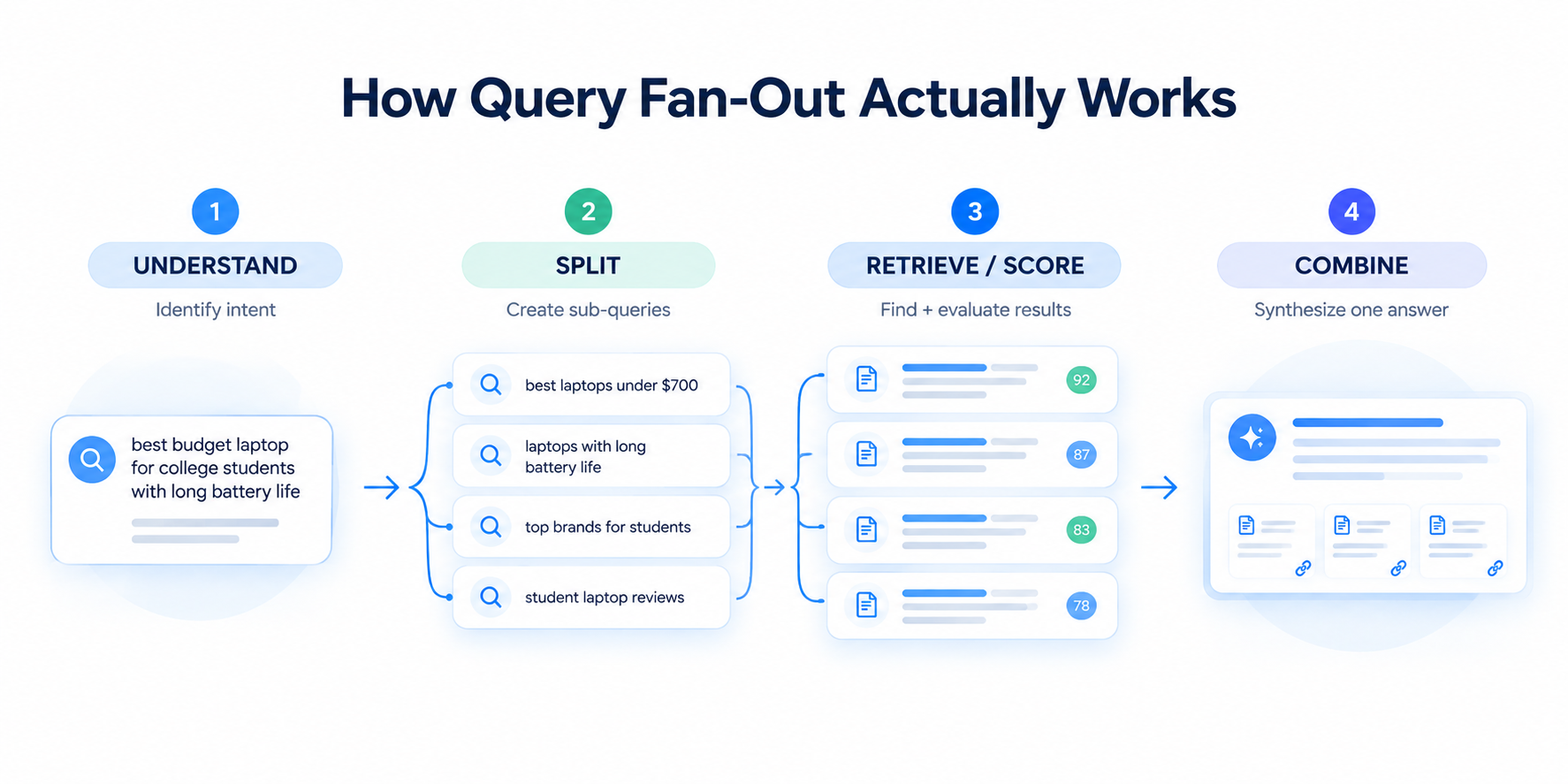
People often start by asking how a query fan-out works before they worry about optimizing for it, so let's answer that clearly first. Google's own search leadership has confirmed the mechanics behind this process.
At Google I/O 2025, the company's Head of Search explained that AI Mode calls on a custom version of Gemini to break a question into subtopics and issue multiple searches on the user's behalf, all before generating one response.
The process generally moves through four stages, one after another, in the time it takes a page to load.
- Understanding the request: The AI model reads the prompt and identifies the different things the person actually wants to know, not just the literal words they typed.
- Splitting it into searches: The system generates several smaller, related searches that each cover one piece of that intent.
- Gathering and scoring results: Each search runs separately, and the system scores the results based on how well they answer that specific piece.
- Combining the answer: The strongest results across every sub-search get merged into one response, with the sources it drew from cited alongside it.
Why AI systems fan out queries instead of answering directly
A single search query is rarely one clean question. Most searches carry a bundle of smaller questions inside them, and a direct answer to only the literal words misses most of what the person actually wants to know.
Fanning the query out lets the AI system check several angles of a topic at once, instead of guessing which single angle matters most.
This is also why pages that cover a topic in genuine depth are starting to outrank pages that only match the exact search phrase, a shift our piece on AI and SEO covers in more detail.
How many sub-queries does one prompt generate?
Google has not published an exact number, and the true count shifts with every request. What stays consistent across independent testing is the pattern. Simple factual prompts trigger only a handful of sub-searches, while complex, multi-part prompts can trigger anywhere from eight to twenty or more.
Deep research modes in tools like Gemini and ChatGPT push that number even higher, sometimes running dozens of background searches for one complex prompt.
Treat these figures as a range reported across independent analyses, not an official count Google has confirmed.
8 Types of Fan-Out Queries (and How to Cover Them in One Page)
AI systems do not generate random sub-queries. They tend to fall into a handful of recognizable patterns, and understanding these patterns is what actually lets you write one page that survives fan-out instead of losing to it.
|
|
|
|
|
|
|
|
|
|
|
|
|
|
|
|
|
|
|
|
|
|
|
|
|
|
|
|
|
|
|
|
|
|
|
|
A single page rarely needs a dedicated section for every type above. It needs enough range across these eight patterns that an AI system can pull a confident answer for whichever sub-query it happens to generate.
For more fan-out query examples on other topics, walk your own core keyword through this same eight-row table before you write.
A 5-Step Framework to Optimize Existing or New Content for Query Fan-Out
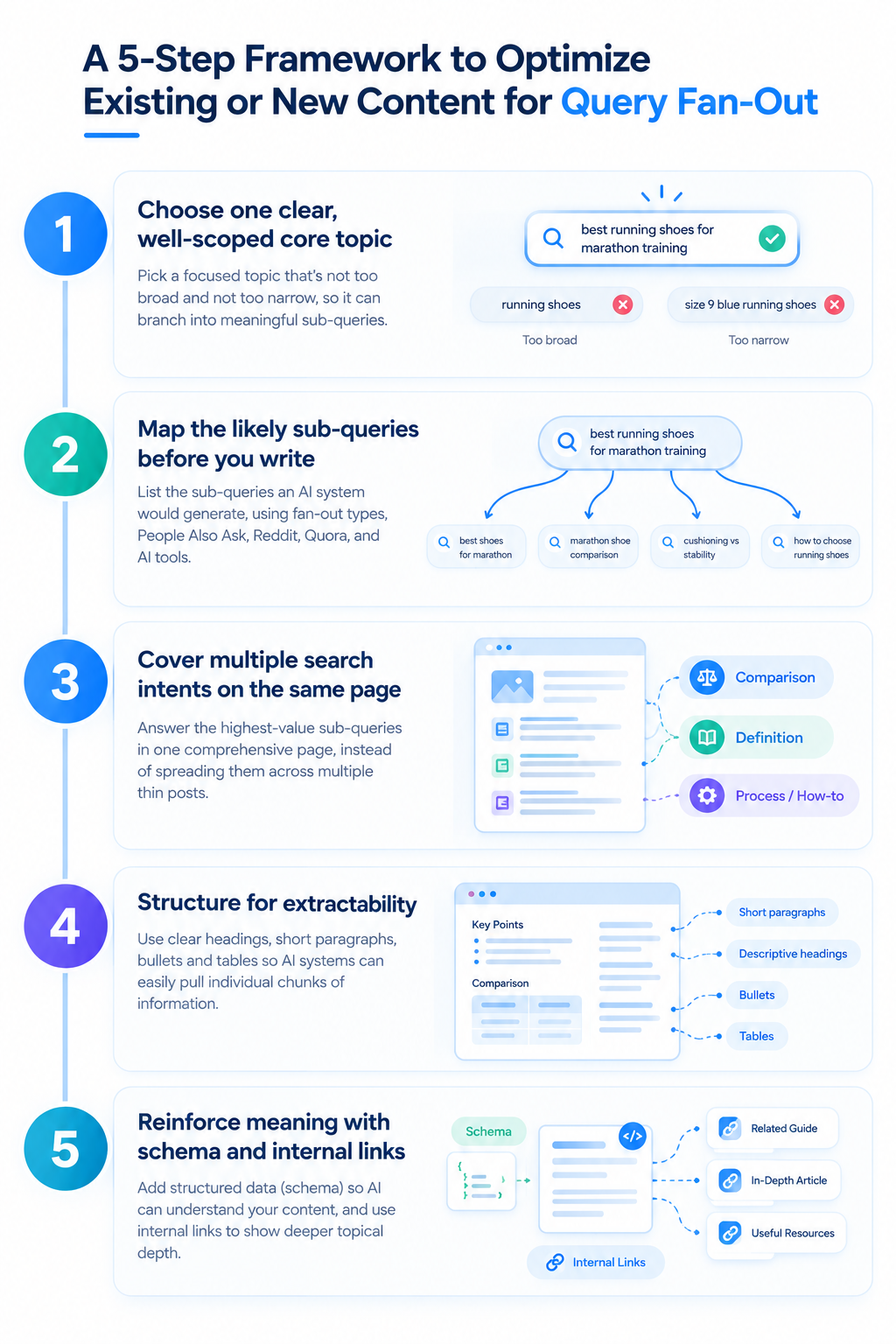
Optimizing for fan-out is not a rewrite of SEO from scratch. It is a shift in what "complete" means for a page, from answering one question well to answering a whole cluster of related questions iquery-fan-out-optimization n the same place.
Step 1: Choose one clear, well-scoped core topic
Every fan-out-ready page starts with one topic that is neither too broad to cover properly nor too narrow to generate real sub-queries. "Running shoes" is too broad for one page, and "size 9 blue running shoes" is too narrow to fan out into anything meaningful.
A well-scoped topic, like "best running shoes for marathon training," gives an AI system enough surface area to branch into comparisons, definitions, and context-specific questions. Our checklist of on-page SEO activities covers the basics of scoping a page correctly before you start writing.
Step 2: Map the likely sub-queries before you write
Before drafting a single sentence, list out the sub-queries an AI system would plausibly generate for your topic. Pull from the eight fan-out types above, and cross-check them against what real people ask in People Also Ask boxes, Reddit threads, and Quora answers on the same subject.
Prompting an AI model directly with your target query and asking it to show its reasoning can surface a working list quickly, alongside free fan-out simulation tools built for this exact task.
Treat this list as a working draft, since the exact sub-queries will shift the next time anyone runs the same prompt.
Step 3: Cover multiple search intents on the same page
Once you have a working list of sub-queries, write sections that directly answer the highest-value ones inside the same page, rather than spreading them across several thin, separate posts.
A comparison sub-query gets its own short comparison section, and a definitional sub-query gets an actual definition, stated plainly.
This is the difference between a page that merely mentions a topic and one an AI system can confidently pull an answer from. Our breakdown of how ChatGPT actually picks sources shows exactly what that confidence looks like from the AI system's side.
Step 4: Structure for extractability
AI systems do not read a page top to bottom the way a person does. They pull specific chunks, a paragraph, a table row, a bullet point, and use whichever chunk answers the sub-query best.
Short paragraphs, descriptive subheadings, and tables for anything comparative all make individual chunks easier to lift cleanly. A 400-word paragraph with the answer buried in the middle rarely gets extracted, even when the information inside it is accurate. Our guide to rich snippets and rich text goes deeper on formatting content for exactly this kind of extraction.
Step 5: Reinforce meaning with schema and internal links
Schema markup gives AI systems a machine-readable label for what a piece of content actually is, a product, a FAQ, an article, so retrieval systems can match it to a sub-query with more confidence. Our recent breakdown of Google's schema updates covers which types still carry weight in 2026.
Internal links do a similar job for humans and crawlers both, connecting a sub-topic mentioned in passing to the page that covers it in full.
A page that links naturally to related, deeper content signals that your site has real depth on the topic, not just one lucky page.
A Worked Example: Turning a Thin Article into Fan-Out-Ready Content
Suppose a small business runs a single blog post titled "Best CRM for Small Law Firms." The original version answers exactly that question in 600 words and stops there, no comparisons, no pricing context, no mention of alternatives.
Reworked for fan-out, the same page keeps its core answer and adds four things around it.
None of this weakens the page's authority on its original topic, the kind of authority our Google E-E-A-T guide explains in more depth.
- A short comparison table against two or three well-known alternatives, covering the comparative sub-queries an AI system is likely to generate.
- A plain-language definition of what a legal CRM does differently from a general one, covering the definitional sub-queries.
- A section on pricing tiers, covering the practical, decision-stage sub-queries a buyer would ask next.
- A closing note on what to evaluate before switching providers, covering the next-step sub-queries that follow a purchase decision.
Nothing about the core topic changed here. What changed is that the page now answers the reformulation, comparative, definitional, and next-step sub-queries an AI system would plausibly generate from that original search, inside the same URL, instead of leaving them for a competitor's page to answer instead.
Common Mistakes When Optimizing for Query Fan-Out
Most fan-out optimization fails quietly, through a handful of avoidable habits rather than one obvious error. Each mistake below is easy to fix once you know to look for it.
- Chasing exact fan-out phrasing like a keyword list: Independent testing has found that only a small share of generated sub-queries stay identical across repeated runs of the same prompt. Optimize for the intent behind a sub-query, not its exact wording.
- Publishing a separate thin page per sub-query Splitting one topic across ten shallow pages usually weakens all ten, since none of them individually demonstrates real depth.
- Ignoring definitional and comparative sub-queries. Pages that only answer the primary question skip two of the most common fan-out types, and lose easy extraction opportunities as a result.
- Writing in dense, unbroken paragraphs. Content that is technically accurate but structurally hard to chunk gets passed over in favor of a competitor's more extractable page.
- Skipping schema entirely. Without structured data, an AI system has to infer what a page is about, which adds friction at exactly the moment speed and confidence decide what gets cited.
- Letting details conflict across your own platforms. Fan-out systems cross-check facts between your website, your Google Business Profile, and third-party listings. A mismatch, like different hours or a discontinued price still listed somewhere, can get your page quietly dropped from a synthesized answer.
- Treating this as a one-time project. Fan-out patterns shift as language models update, so a page optimized once in early 2026 can quietly fall behind by year's end without a periodic review.
How to Measure Whether Your Content Is Winning Fan-Out Visibility
Fan-out visibility does not show up cleanly in traditional rank tracking, because there is no single keyword position to check. You are measuring whether your content gets pulled into AI-generated answers at all, and how often it happens across a cluster of related sub-queries.
- Check AI citations directly: Run your target prompts inside Google AI Mode, ChatGPT, and Gemini yourself, and note whether your domain gets cited and for which sub-questions.
- Use Gemini's grounding data where available: Google's Gemini API can return the exact background searches it ran for a grounded response, giving you a first-party look at real fan-out queries instead of a guess.
- Watch AI referral traffic in analytics: A rising trickle of sessions from AI platforms, even a small one, is often the earliest sign a page has started getting cited.
- Track citation frequency over time, not a single snapshot: One independent study analyzing more than 170,000 URLs found that pages ranking for more fan-out queries were 161% more likely to appear inside query fan-out AI Overviews results, a gap worth re-checking quarterly as your content coverage grows.
Query Fan-Out for Bangladeshi and Emerging-Market Businesses
Query fan-out changes the local SEO calculation for businesses outside the biggest English-language markets too.
AI Mode and AI Overviews are still rolling out unevenly by country, but the underlying retrieval behavior already shapes how Google, Gemini, and ChatGPT answer questions about Bangladeshi products, services, and prices.
Our blog on investing in SEO for Bangladeshi businesses covers the broader opportunity this shift creates.
A Dhaka-based business competing for a query like "best ERP software in Bangladesh" is not just competing for that literal phrase anymore.
An AI system fanning that query out might generate sub-searches for pricing in taka, local implementation support, or comparisons against international providers, and a page that only answers the original phrase misses all of them.
This is exactly the kind of gap our overview of digital marketing in Bangladesh points local businesses toward closing.
Local and emerging-market brands actually hold a real advantage here, if they use it. Thin, English-only content translated straight from a global template rarely covers the specific sub-queries a Bangladeshi searcher's context generates, things like local pricing, delivery timelines, or region-specific regulations.
A page written with that local context built in from the start tends to out-cover a bigger, more generic competitor on exactly the sub-queries that matter most.
Key Takeaways
Query fan-out is not a passing trend. It is how AI-powered search now works by default, and it rewards depth over exact-match keyword targeting.
- Query fan-out splits one search into several parallel searches, then merges the strongest answers into one response.
- Fan-out queries are synthetic and shift between runs, so optimize for the intent patterns behind them, not their exact wording.
- Covering multiple search intents in one well-structured page beats spreading thin coverage across many separate pages.
- Schema markup and clean internal linking both help AI systems retrieve and trust your content with more confidence.
- Measuring fan-out visibility means tracking AI citations and referral traffic over time, not a single keyword ranking.
Final Thoughts
Query fan-out rewards the same instinct good writers already have. Answer the whole question, not just the words used to ask it. The businesses that treat this as a reason to go deeper on fewer, better pages will keep showing up in AI answers long after this specific term stops trending.
Our explainer on what SearchGPT changes for search covers the wider shift this framework sits inside. Build for genuine completeness first, and the citations tend to follow.
Most Common FAQs on How to Optimize for Query Fan-Out
What is query fan-out?
Query fan-out is the process AI search systems use to break a single user query into multiple related sub-queries, retrieve information for each one, and merge the strongest results into one synthesized answer.
Google popularized the term through AI Mode, and the wider industry now uses it to describe similar behavior in tools like ChatGPT and Gemini.
How does query fan-out actually work?
An AI model first analyzes a prompt to identify the different intents hiding inside it, then generates several smaller searches that each target one of those intents. Each search runs and gets scored separately, and the system merges the strongest results into a single response with sources cited.
How many sub-queries does AI run per prompt?
The exact number depends on how complex the prompt is and which AI system is handling it. Simple factual prompts might trigger only a few sub-searches, while complex, multi-part prompts can trigger anywhere from eight to twenty or more, based on independent testing rather than an official figure from Google.
Does schema markup help with query fan-out?
Schema markup helps by giving AI systems a clear, machine-readable label for what a piece of content actually is, which makes it easier to match against a specific sub-query. It is not a guaranteed citation trigger on its own, but it removes friction that can otherwise cost you a citation to a competitor's clearer page.
Are fan-out queries the same as long-tail keywords?
No. Long-tail keywords are phrases real people type into a search bar and carry their own search volume, while fan-out queries are generated on the fly by an AI model and shift from one run to the next. Treat fan-out queries as intent signals to cover, not literal keywords to chase one by one.
Does query fan-out apply to ChatGPT and other LLMs, or just Google AI Mode?
Query fan-out applies well beyond Google AI Mode. Google coined the specific term, but the same break-it-into-sub-queries behavior shows up in ChatGPT, Gemini, and other LLMs whenever a prompt needs information beyond the model's built-in knowledge.
How do I find the fan-out queries relevant to my topic?
Start with People Also Ask results, related searches, and Reddit or Quora threads on your topic, since these reflect the same underlying intents an AI system is likely to generate. Purpose-built fan-out simulation tools can supplement this, but treat any list they produce as a rough guide rather than a fixed target.
How does query fan-out affect ecommerce and product pages?
Query fan-out affects product pages by generating sub-queries around specifics like price, size, color, availability, and comparisons against similar products. Product pages that clearly state these details in structured, extractable formats get pulled into AI-generated shopping answers far more often than pages that bury them in marketing copy.
Do I need to create a separate page for each fan-out query?
No, and doing so usually backfires. A handful of well-structured pages that each cover a cluster of related sub-queries in real depth consistently outperform dozens of thin pages built around individual fan-out phrases