Local SEO for Restaurants: Tips to Boost Your Visibility in Search
- Post By: FAISAL MUSTAFA
- Published: September 19, 2026


Local SEO for restaurants means optimizing your Google Business Profile, website, and reviews so hungry diners searching nearby find your restaurant before they find the one three doors down. Google decides which restaurant "wins" that search in milliseconds, using signals most owners never touch.
That decision happens before a single dish reaches the table. A diner types "best biryani near me" or "brunch spot open now," and Google picks three restaurants to show first. If yours is not one of them, the sale is already gone to a competitor.
In this blog, you will find practical restaurant SEO tips covering how Google actually ranks restaurants, how to optimize your Google Business Profile and website, how reviews and schema markup affect visibility, and how to show up when diners ask ChatGPT or Google AI where to eat.
We will also cover the mistakes that quietly cost restaurants customers and how affordable local SEO turns all of this into steady bookings, even on a small budget.
How Google Ranks Restaurants in Local Search
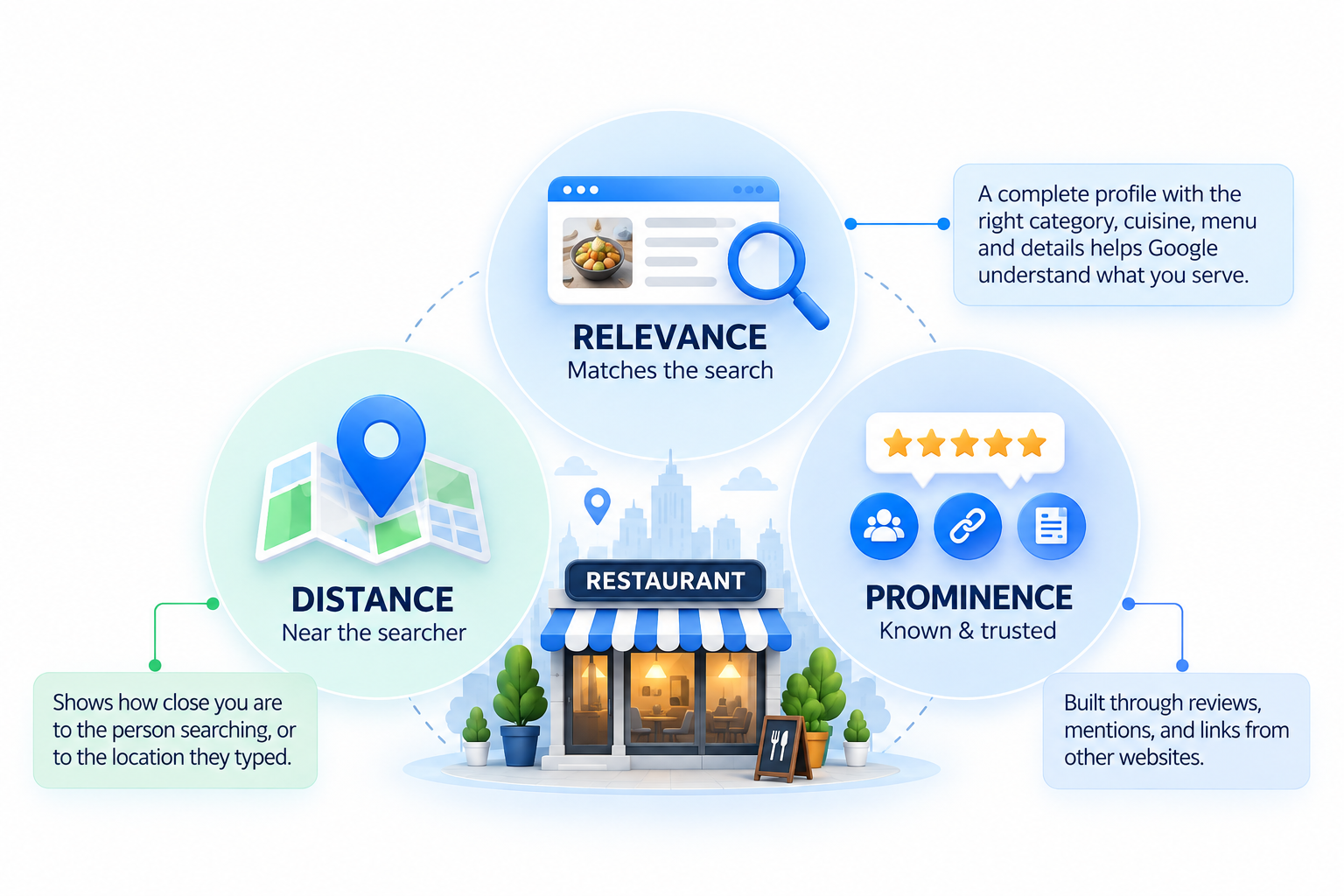
Google decides which restaurants to show using three main signals, not one hidden formula. Restaurant owners who understand these three signals can predict, and influence, why a competitor keeps outranking them.
Google's own Business Profile documentation states that local results are based mainly on relevance, distance, and popularity.
These three factors work together every time someone searches for a place to eat nearby, and each one responds to a different set of actions from you.
Relevance, Distance, and Prominence Explained
Each of the three signals plays a different role, and only two of them are within your control. Knowing which lever to pull saves time compared to guessing.
- Relevance measures how well your profile matches the search. A completed profile with the correct category, cuisine, and menu details tells Google exactly what you serve.
- Distance measures how close you are to the searcher or to the location they typed. You cannot move your restaurant, but an accurate address and service area help Google place you correctly on the map.
- Prominence measures how well-known and trusted your restaurant is. Reviews, mentions on other websites, and links from local publications all build prominence over time.
Most restaurants lose visibility on relevance and prominence, not distance. A restaurant two streets further away, with more reviews and a fully optimized profile, regularly outranks a closer restaurant with a thin listing.
That gap is exactly how to rank higher on Google for restaurants without changing your address.
Check how local SEO differs from general SEO if you want the fuller picture before diving into the fixes below.
Claim and Optimize Your Google Business Profile
Your Google Business Profile is the single most important asset in restaurant SEO. It is what shows up in the Local Pack, in Google Maps, and often in AI Overviews before a diner ever visits your website.
A properly built Google Business Profile for restaurants does more heavy lifting than almost any other single fix on this list.
An unclaimed or half-filled profile gives Google very little to work with, so it fills the gaps with whatever data it can scrape from elsewhere. Claiming and completing your profile puts you back in control of what diners see.
Get Your NAP (Name, Address, Phone) Exactly Right
NAP stands for Name, Address, and Phone number, and it needs to match character for character everywhere your restaurant appears online.
Even small mismatches, like "St." on one site and "Street" on another, confuse Google's confidence in your listing. NAP consistency for restaurants matters more than for most other business types. Diners cross-check your details across several apps before ever calling.
Check your Google Business Profile against your website footer, your Facebook page, and any delivery app listing. Fix mismatches one at a time, starting with your Google Business Profile since it carries the most weight.
Add Photos, Attributes, and a Live Menu
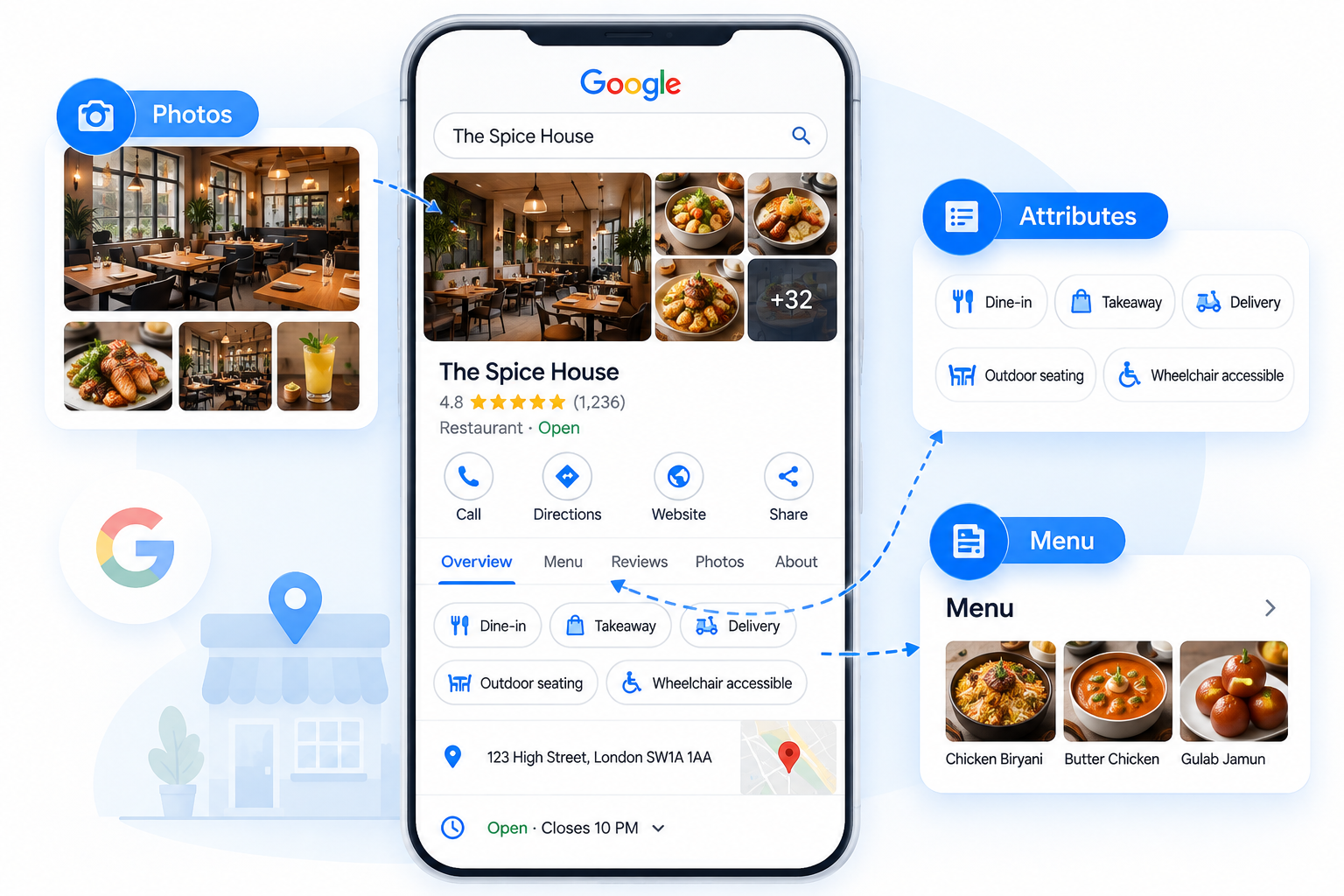
A restaurant profile without recent photos looks abandoned, and diners scroll past it in seconds. Google also rewards profiles that use every relevant field, since a complete profile is a stronger relevance signal.
- Upload real photos weekly. Interior shots, plated dishes, and your storefront perform better than stock images and build trust faster.
- Fill in every attribute. Options like outdoor seating, dine-in, delivery, and accessibility features help you match more specific searches.
- Add your menu directly to the profile. A menu inside Google Business Profile gets indexed for dish-level searches, which a PDF link often does not.
Compressing and naming your photos properly also feeds into on-page SEO. Our image SEO Blog covers the file naming and alt text habits that help your restaurant photos get discovered in Google Images, too.
Use Google Posts to Stay Active
Google Posts let you publish short updates, offers, and events directly on your profile, and they show recent activity to anyone viewing your listing. A profile that posts regularly signals to Google that the business is active and well managed.
Post weekly specials, seasonal menu changes, or upcoming events. Keep each post short, add a clear photo, and include a call to action like "Order Now" or "Book a Table."
Turn Reviews Into a Ranking Signal
Reviews sit at the center of prominence, one of Google's three core local ranking factors. They also influence the decision a diner makes in the ten seconds after finding your listing.
A restaurant with 200 reviews and a 4.6 rating beats a restaurant with 12 reviews and a 5.0 rating almost every time, because Google and diners both read volume as trust.
Our detailed breakdown on whether Google reviews help SEO walks through exactly how ratings, review count, and review recency each carry weight.
How to Ask for Reviews Without It Feeling Awkward
Most diners are happy to leave a review, but they rarely think to do it unless asked at the right moment. The trick is making the ask feel like a natural part of the experience, not a sales pitch.
- Ask at the moment of highest satisfaction. The end of a good meal, right before the bill, works better than a follow-up email days later.
- Make the link one tap away. A QR code on the receipt or table tent removes the friction of searching for your business on Google.
- Train staff to mention it once, briefly. A simple "if you enjoyed tonight, a review helps us a lot" is enough, no script needed.
How to Respond to Reviews (Especially Negative Ones)
Responding to reviews shows Google an active, engaged business, and it shows future diners how you handle problems. A pattern of unanswered negative reviews often does more damage than the reviews themselves.
Reply to positive reviews with a short, specific thank you rather than a copy-pasted line. For negative reviews, acknowledge the issue, keep the tone calm, and move the conversation offline with a phone number or email.
Never argue in public, and never offer discounts or free items in exchange for reviews, since that violates Google's policies and can get reviews removed.
If you suspect a review is fake or posted by a competitor, our blog on the dark side of Google Local Guides explains how to flag it correctly.
Target the Keywords Diners Actually Search
Diners rarely search the way restaurant owners describe their own food. Matching the words customers actually type is often a bigger visibility win than any technical fix.
Restaurant keywords generally fall into three groups, and a strong page uses all three instead of just one.
|
|
|
|
|
|
|
|
|
|
|
|
|
|
|
|
Cuisine, Dish, and Experience-Based Keywords
Cuisine keywords bring in the largest volume of searches, but they are also the most competitive. Dish and experience keywords bring fewer searches, but the diners typing them already know exactly what they want, which makes them convert faster.
A page built only around "restaurant near me" misses all the specific, high-intent searches happening around your signature dishes and your dining experience. Cover both to capture the full range of how diners search.
Where to Place Keywords (Title, Meta, Headings, GBP Description)
Placement matters as much as choosing the right words. Google and diners both scan the same few spots first, so those spots need to carry your strongest keywords.
- Page title: Lead with your primary cuisine or dish keyword, followed by your neighborhood.
- Meta description: Mention your specialty and a reason to click, like a signature dish or ambiance.
- H1 and headings: Use natural variations of your keywords, not the exact same phrase repeated.
- Google Business Profile description: Describe your cuisine, specialties, and neighborhood in plain language within the first two sentences.
Getting this structure right across your whole site connects directly to core on-page SEO practices, which apply to restaurant websites just as much as any other business.
Avoid Keyword Stuffing
Repeating the same keyword phrase over and over reads as spam to both Google and diners. It also makes your content harder to read, which increases bounce rate and undermines the exact relevance signal you are trying to build.
Write for the person reading first, then check that your target keywords appear naturally two or three times per page. If a sentence sounds awkward because a keyword was forced into it, rewrite the sentence.
Get Listed Consistently Across Directories
Directory listings, also called citations, confirm your restaurant's details across the web and feed directly into the prominence signal. Inconsistent listings quietly undercut every other SEO effort you make.
Core Directories to Prioritize
Not every directory carries equal weight, and restaurants benefit from a slightly different mix than most other local businesses. Focus your time on the platforms diners actually check before booking a table.
- Google Business Profile is the foundation and should always be updated first.
- Yelp carries strong trust signals for restaurants specifically, more than most other industries.
- TripAdvisor matters heavily if you attract tourists or business travelers.
- Zomato and similar food-focused platforms often influence local discovery searches directly.
- Facebook still functions as a directory for many diners checking hours and photos.
For a full explanation of how citations work and which ones matter most for your market, read our writing on local SEO citations.
How to Find and Fix Inconsistent Listings
Inconsistent listings usually accumulate over years, often from a past house move, a phone number change, or a previous owner's data. Finding them manually is tedious, but skipping this step leaves conflicting signals live across the web.
Search your restaurant's name plus city in Google and check the first few directory results by hand. Update each mismatch directly on that platform, and set a calendar reminder to recheck every six months, since directories can silently revert changes during their own data refreshes.
Build Prominence with Local Content and Backlinks
Google's prominence signal, covered earlier, does not come only from reviews. It also comes from how often other websites mention and link back to your restaurant, and content is what earns those mentions.
Turn Your Food Into Blog Content
A restaurant blog gives you somewhere to publish the stories a review site or directory never will. Regular local content also gives Google fresh, keyword-rich pages beyond your homepage and menu.
- Share seasonal menu stories. A short post on a new seasonal dish or a chef's pick gives you a natural home for dish-specific keywords.
- Cover local events and collaborations. Posts about a food festival, a local supplier, or a pop-up event connect your restaurant to neighborhood searches.
- Answer real diner questions. Topics like "best dishes for a group dinner" or "do you have a vegan menu" match how people actually search.
Earn Backlinks From Food Blogs and Local Press
A link from a local food blogger or neighborhood publication tells Google your restaurant matters beyond your own website. These links build prominence in a way your own content never can on its own.
Reach out to local food writers with a genuine story, not a generic pitch, and offer a tasting or interview in exchange for honest coverage.
Sponsoring a small local event or partnering with a nearby business on a joint feature also tends to earn links naturally over time.
Our blog on building high-quality backlinks covers outreach tactics that apply directly to a restaurant's local market.
Optimize Your Website for Local Search
Your Google Business Profile gets diners to notice you, but your website is what confirms the decision and, ideally, converts the visit into an order or a reservation. A slow, hard to use website undoes a lot of the work a strong profile does.
Make Your Menu Text-Based, Not a PDF or Image
Google cannot read a menu inside a PDF or a photo nearly as well as it can read plain text on a page. A text-based menu also lets you target specific dish keywords that a scanned menu never will.
Rebuild your menu as an actual page with headings for each category and real text for every dish name and description. Keep a downloadable PDF as a backup option, never as the primary version.
Speed and Mobile-Friendliness
Most restaurant searches happen on a phone, often while someone is already outside deciding where to walk. A slow-loading site loses that customer to the next result before the page even finishes loading.
Compress your images, remove unnecessary plugins, and test your site on an actual phone, not just a desktop browser resized smaller. Our mobile SEO guide covers the specific technical checks worth running on a restaurant website.
Keep Online Ordering and Reservations On Your Own Site
Routing every order through a third-party delivery app gives away commission and, over time, gives that app your customer relationship too. Keeping ordering and reservations on your own domain also strengthens the pages Google ranks for your brand.
Use an ordering plugin or reservation widget that lives on your own website first, and treat delivery apps as an additional channel rather than the default path. This also gives you first-party data on your regulars, which no aggregator will hand back to you.
Use Schema Markup to Help Google Understand Your Restaurant
Schema markup is structured code added to your website that tells Google exactly what each piece of information means, rather than leaving Google to guess. For restaurants, this is one of the highest-leverage technical fixes available.
Restaurant schema can explicitly define your cuisine type, price range, opening hours, accepted payment methods, and menu items in a format search engines and AI systems can read directly.
A basic example looks like this:
|
|
LocalBusiness and Restaurant schema remain fully supported even after Google's recent cleanup of several rich result types. Our breakdown of the schema types Google recently dropped explains which markups still matter and which ones you can skip.
Getting this code onto your site usually needs a developer, but the payoff is a listing Google, and increasingly AI search tools, can trust without guessing.
Show Up When Diners Ask ChatGPT or Google AI Where to Eat
Diners increasingly ask ChatGPT, Gemini, or Google's AI Overviews for restaurant recommendations instead of typing a plain search. These systems pull from your Google Business Profile, your website content, reviews, and structured data to build an answer, so the same fundamentals covered above still decide whether you appear.
AI systems favor restaurants with clear, consistent information over restaurants with vague or conflicting details across the web. A profile that clearly states your cuisine, price range, specialties, and neighborhood gives an AI model an easy, confident answer to hand a diner.
This is the core idea behind restaurant AI search optimization, and it builds directly on the same GBP and review fundamentals covered earlier.
Our blog on Answer Engine Optimization explains this shift in more depth, and our explainer on what Google AI Mode changes for search covers how AI-generated answers are reshaping who gets recommended.
Restaurant-specific steps for AI visibility include:
- Keep facts consistent everywhere: AI models cross-check your website, GBP, and directories, and conflicting hours or addresses reduce confidence in recommending you.
- Write your menu descriptions in plain language: Clear, specific dish descriptions extract cleanly into an AI answer, while vague marketing copy does not.
- Earn mentions on food blogs and local publications: Third-party coverage reads as independent proof, which AI systems weigh more heavily than anything on your own website.
7 Restaurant SEO Mistakes That Are Quietly Costing You Customers
Most restaurants do not lose local search visibility from one big error. They lose it gradually, from a handful of small oversights that compound over months.
Run through this list like a restaurant SEO checklist and fix whichever items apply to you first.
- Leaving your Google Business Profile half-finished: Missing hours, an empty menu section, or no attributes filled in quietly weakens your relevance signal every single day it stays incomplete.
- Ignoring negative reviews: A pattern of unanswered complaints tells both Google and future diners that nobody is managing the business online.
- Using a PDF or photo as your only menu: It blocks Google from indexing your dishes and blocks diners on slow connections from even opening it.
- Letting NAP details drift out of sync: A different phone number on one directory than on your website undermines the trust Google places in your listing.
- Skipping mobile optimization: Most restaurant searches happen on a phone, and a slow or broken mobile site loses the sale before a diner even sees your menu.
- Relying only on delivery apps for online ordering: It hands over commission and customer data while doing nothing for your own website's search visibility.
- Publishing generic content with no local detail: A page that never mentions your neighborhood, your specific dishes, or your actual customers gives Google very little reason to rank it for local searches.
Fixing even two or three of these consistently moves the needle faster than chasing every advanced tactic at once.
If you want the complete framework these mistakes tie back to, our local SEO strategy guide lays out the full eight-step approach.
How VISER X Can Help with Restaurant Local SEO
Restaurant SEO touches your Google Business Profile, your website, your reviews, and increasingly your visibility inside AI search tools. Juggling all four while running a restaurant is genuinely hard.
This is exactly why many owners eventually bring in a restaurant SEO agency once growth stalls. VISER X handles this as a coordinated system rather than a list of disconnected tasks, structured the way strong restaurant SEO services should be.
Our local SEO service covers Google Business Profile optimization, citation cleanup, review strategy, schema implementation, and website performance, built specifically around how diners actually search.
If your restaurant's visibility has plateaued, or you are starting from scratch, talk to our team about a plan built around your neighborhood and your menu.
Key Takeaways
Restaurant SEO is not one task. It is a small set of habits, repeated consistently, across your Google Business Profile, your website, your reviews, and your directory listings.
- Google ranks restaurants on relevance, distance, and prominence, and only two of those three are within your control.
- A fully completed Google Business Profile, updated weekly with photos and posts, remains the single highest-leverage asset you have.
- Reviews and how you respond to them directly shape both your ranking and a diner's decision to walk in.
- Local content and backlinks from food blogs and neighborhood press build the same prominence signal reviews do, just from a different direction.
- A text-based, mobile-friendly website with schema markup helps both Google and AI search tools recommend you confidently.
- Small, unresolved mistakes, like an inconsistent phone number or an abandoned profile, quietly cost more customers than most owners realize.
Final Thoughts
Restaurant SEO comes down to a few habits, repeated without gaps. Keep your Google Business Profile complete, keep reviews and local content flowing, and keep every listing pointing to the same name, address, and phone number.
Diners decide where to eat in seconds, and Google shows them the restaurant it trusts most in that moment. Build that trust deliberately, and the visibility follows.
Most Common FAQs on Local SEO for Restaurants
What is local SEO for restaurants, and how does it work?
Local SEO for restaurants is the practice of optimizing your Google Business Profile, website, and online reviews so your restaurant appears when nearby diners search for a place to eat.
It works by strengthening the same three signals Google uses to rank every local business, which are relevance, distance, and prominence, through accurate business information, consistent listings, and active review management.
How much does local SEO cost?
Local SEO for a single restaurant with light competition typically costs BDT 15,000 to 40,000 per month, mainly covering Google Business Profile management, citations, and review strategy.
A multi-location restaurant group in a dense market like Dhaka or Chittagong can expect BDT 50,000 to 150,000 or more per month for a fuller campaign. Most Bangladeshi agencies price serious, sustainable local SEO work in the BDT 30,000 to 60,000 range, since anything lower rarely covers real technical fixes and content.
Your actual budget depends heavily on how competitive your local dining market is and how much of the work you can realistically handle in-house.
How can I do local SEO myself?
You can handle a meaningful part of local SEO yourself if you have a few hours a week to commit consistently. Start by fully completing your Google Business Profile, asking happy customers for reviews, keeping your NAP details identical across every directory, and posting weekly updates with fresh photos.
This DIY approach works well for a single restaurant in a less competitive area, though a dense market or multiple locations usually benefits from outside help.
Does responding to reviews really improve local SEO?
Responding to reviews is not a confirmed direct ranking factor on its own, but it strengthens the prominence signal Google already weighs heavily. An actively managed profile with thoughtful responses also improves how diners perceive your restaurant, which increases clicks, visits, and the overall engagement signals Google associates with trustworthy businesses.
What's the fastest way to rank higher on Google for my restaurant?
The fastest, highest-impact move is completing every section of your Google Business Profile, since it directly strengthens the relevance signal Google checks first.
Pair that with a steady flow of new reviews and consistent NAP details across your top directories, and most restaurants see a measurable shift in local visibility within a few weeks rather than months.