How to Integrate SEO, Google Ads, Meta Ads, and Content Marketing Into One Strategy
- Post By: FAISAL MUSTAFA
- Published: October 28, 2026
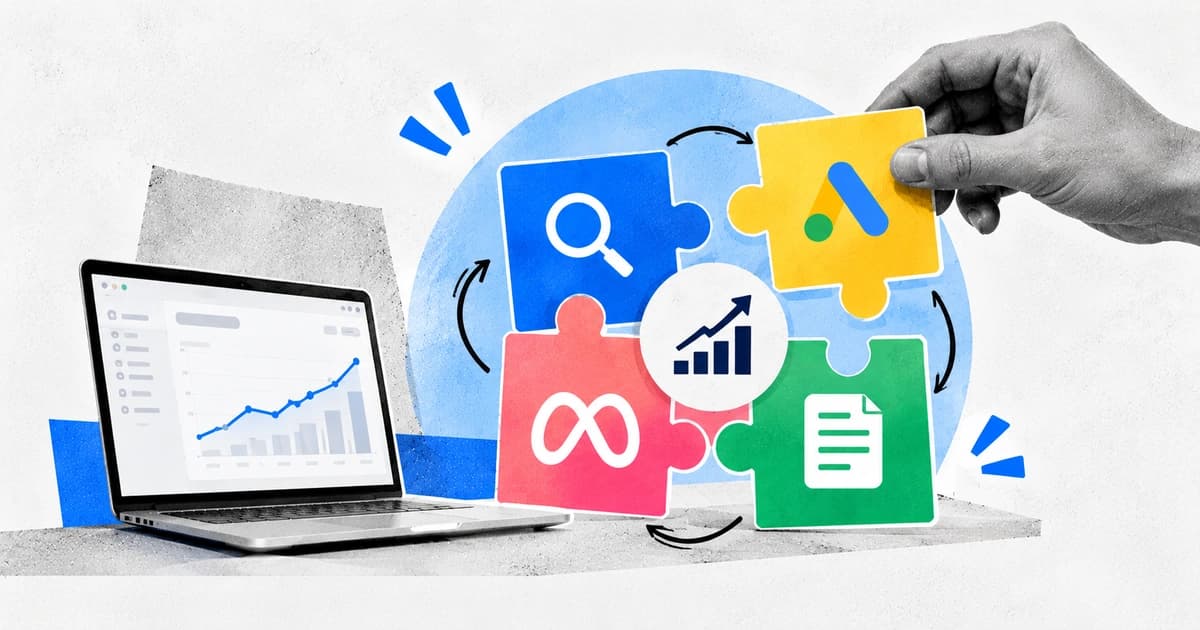


To integrate SEO, Google Ads, Meta Ads, and content marketing into a single strategy, you must unify all four channels around a single business goal, a shared audience and keyword dataset, and a single CRM-driven measurement layer.
Instead of running each channel in a silo, treat them as an interconnected system: use Meta Ads and content marketing to generate demand and build warm audiences; deploy Google Ads to rapidly test conversion-ready keywords and capture high-intent search traffic; and leverage SEO to scale proven winning search terms for long-term organic growth.
Connecting these channels allows each piece of content and ad spend to reinforce the others, turning fragmented tactics into a unified engine for sustainable revenue growth.
Working with the best digital marketing agency can help streamline this process by aligning your team around a shared roadmap, establishing cross-channel retargeting loops, and continuously reallocating budget to maximize your overall return on investment.
What an Integrated Strategy Actually Means (and What It Isn't)
An integrated strategy runs SEO, Google Ads, Meta Ads, and content from a single plan, a single dataset, and a single scorecard. Each channel does a different job for the same buyer.
Four campaigns that run side by side with separate goals are not integration. They are just an activity.
Integration is a system, not a campaign
A campaign starts and ends. A system keeps running and keeps learning. In a system, a search term that converts in Google Ads becomes a page brief for SEO.
A blog post that earns attention becomes a Meta ad. A lead that closes in your CRM teaches both ad platforms how to find the next.
That is what cross-channel marketing means in practice. It also forms the base of any real omnichannel marketing strategy, which aims to give buyers a smooth experience at every touchpoint.
You cannot give a smooth experience if your channels never share information.
Signs your channels are working in silos
Your channels work in silos when each one reports its own wins, and nobody can name the cost of one customer. Marketing silos also show up in daily work. If you answer yes to two or more of these, you are paying for the gap.
- Your SEO and ads people have never shared a keyword list.
- Your ads and your blog promote different offers to the same audience.
- Google, Meta, and your CRM each show a different lead count.
- You cannot say which channel produced your last ten customers.
- Your retargeting still shows ads to people who have already bought.
Why Integration Matters More in 2026
Integration matters more in 2026 for three reasons.
AI answers take informational clicks. Ad platforms learn from the data you send them. And each channel now depends on the others to do its job well.
AI Overviews and AI Mode are absorbing informational clicks
Google's AI answers now settle many informational searches before anyone clicks. The randomized study found a 38% drop in organic clicks when an AI Overview appeared.
Pew Research, as reported by Search Engine Journal, found that people clicked a result 8% of the time with an AI Overview and 15% without one.
SparkToro's 2026 data, reported by TechWyse, put US Google searches that ended without a click at 68.01%.
Not every search suffers equally. The same SparkToro report says branded, local, and high-intent buying searches hold up better than informational ones. That is where Google Ads and strong organic pages earn their keep.
A content page now has two jobs: win the click, and earn a mention inside the AI answer. AI Mode, Google's chat-style search, also answers questions directly, so the same rule applies.
Platforms optimize on your data, so siloed data means weaker campaigns
Google Ads and Meta Ads both use machine learning to pick who sees your ads. They learn from the conversion data you send.
If you send only form fills, they find more form fillers. If you send closed sales from your CRM, they learn to find buyers.
Google Ads Help says advertisers who sent first-party data, such as email addresses and phone numbers, along with click IDs in their offline imports saw a median 10% increase in conversions compared with standard imports.
In our ad account audits, most accounts cannot say what happened to a lead after the form. Those accounts feed the platform's weak signals, and the campaigns show it.
Demand creation and demand capture depend on each other
Demand creation and demand capture are two halves of one job. Meta Ads and content make people want something they were not searching for.
SEO and Google Ads catch people once they start searching. Skip creation, and search volume for your offer stays flat. Skip capture, and you pay to build interest that a rival collects.
Brand awareness work on Meta also tends to lift the branded searches that Google Ads and SEO capture later. Treat the two halves as one loop, and measure them together.
The Channel Role Map: What Each Channel Does in One Funnel
Each channel has a different job in the same funnel. Meta and content create interest.
SEO and Google Ads capture it. Retargeting and content close it. Set these roles before you spend, so no channel tries to do everything.
|
|
|
|
|
|
|
|
|
|
|
|
|
|
|
|
|
|
|
|
|
|
|
|
|
|
|
|
|
|
SEO: long-term demand capture and AI search visibility
SEO captures people who search, and it keeps working after you stop paying for it. Pages that rank well and answer questions clearly also give AI answers material to cite.
Think of SEO as the asset you own, built on keyword research, useful pages, and a healthy site. Our SEO services start from that base.
Hatil Furniture shows what this looks like. Our team started with an audit, fixed technical issues, ran keyword research, and improved product and category content.
Between March and July 2024, organic traffic rose 116.07%, and the site logged over 4 million Google impressions. The Hatil Furniture case study also notes that the work lowered the brand's dependence on paid media.
Google Ads: immediate, high-intent demand capture
Google Ads puts you in front of people who are searching right now, so you get answers in days, not months. It fits buying-intent terms, branded searches, and pages you want to test before you invest in ranking them.
Strong Google Ads management also turns the account into a research tool, because the search terms report shows the exact words buyers type.
Meta Ads: demand creation, audience building, and retargeting
Meta Ads reach people who are not searching yet. Use paid social to introduce your offer, then build retargeting audiences from site visitors, video viewers, and form starters.
Good Meta Ads management brings those warm people back to the pages that SEO and content built.
Content marketing: the shared fuel for all three
Content gives every channel something worth clicking. One guide can rank in search, serve as a Meta lead magnet, and act as a stronger Google Ads landing page.
That is the core of SEO and content marketing, and it is where content marketing strategy planning begins: ensuring every asset has a clear path for how each channel will carry it. Our team follows that rule for every campaign.
Step-by-Step: How to Build the Integrated Strategy
Build the strategy in seven steps. Set one goal, build one research base, map content to the funnel, test with paid and scale with SEO, test the overlap, connect retargeting, and build one measurement layer. Work in this order, because each step feeds the next.
Step 1: Set one business goal and one customer definition
Pick one business goal, such as booked consultations or online orders, and write a short description of your best customer. Every channel then works toward the same number.
Without this step, SEO chases traffic, ads chase cheap leads, and nobody chases revenue.
Strata Hygiene, a property maintenance company in Australia, came to us with a clear target in mind.
The aim was to maximize confirmed bookings while keeping cost per acquisition lean, with an average client value of $250. Both the Google and Meta campaigns then aimed at that same outcome.
Action Item: Write your goal as a number with a date. Then define "customer" in your CRM, so every team counts the same thing.
Step 2: Build one research base (keywords, audiences, questions)
Do the research once and share it. Pull terms from keyword research tools, real words from your search terms report, and your own Search Console queries.
Add audience data from Meta, along with the exact questions your sales team hears. Store everything in one sheet that every channel uses.
|
|
|
|
|
|
|
|
|
|
|
|
|
|
|
|
|
|
|
|
Pro Tip: Sort your search terms report by conversions, not clicks. Terms that convert go to the top of your SEO page list.
Step 3: Map content to funnel stages and channels
Give every funnel stage a content type and a home channel. Awareness content goes to Meta and search. Comparison content goes to SEO and Google Ads.
Decision content, like pricing pages and case studies, needs the tightest landing page alignment with your ads. This is how a full funnel marketing strategy looks on paper.
|
|
|
|
|
|
|
|
|
|
|
|
|
|
|
|
|
|
|
|
|
|
|
|
|
Step 4: Use paid media to test, SEO to scale
Run new topics and offers through paid ads first. Within days, you learn which headlines, offers, and pages convert. Then build the winners into SEO pages that keep earning. This order saves months of guessing.
That is the simplest answer to how to integrate SEO and PPC, and it is the core of SEO and PPC integration. Take a keyword that converts in Google Ads and write a deeper page for it.
Take a Meta ad that earns cheap engagement and turn the idea into a blog post. When you run SEO and PPC together this way, each channel makes the other cheaper to run.
Step 5: Handle paid and organic overlap with tests, not assumptions
Do not pause ads just because you rank first, and do not keep them running just because they show a return. Run a holdout test on your brand terms and measure total conversions. The research on paid search and organic search overlap is mixed, so test your own account.
A Google study, covered by Search Engine Land, found that when a brand held the top organic spot, 50% of its ad clicks were incremental. At organic positions two to four, 82% were. At position five or lower, 96% were.
A Search Engine Land test went the other way on one account. After a company paused about $113,000 a month in paid search, organic, and direct traffic, it recaptured 30% of the paid-attributed revenue within six weeks and 65% by week 13.
Both results say the same thing: the answer depends on your account.
Heads Up: Revenue is not profit, so compare profit before and after any pause test, not just revenue.
Step 6: Connect retargeting across channels
Build audiences from every channel and use them everywhere. Visitors who come from SEO can see Meta ads. People who clicked on a Google ad but did not make a purchase can see a case study. Exclude buyers from every list to stop paying to chase customers you already won.
This is how Google Ads and Meta Ads together beat either one alone. Google brings in people with intent, and Meta keeps your offer in front of them while they decide.
The Strata Hygiene campaign needed exactly this coordination, with creative matched to each buyer stage across both platforms to avoid message fatigue and audience overlap. On $49,710 in ad spend, the Strata Hygiene case study reports 1,972 client confirmations.
Step 7: Build one measurement layer
Send every lead and sale into one place, usually your CRM, and report from there.
Use CRM integration, the Conversions API, and offline conversion import to send closed deals back to Meta and Google. The platforms then optimize for customers, not form fills.
Meta sets rules for this. Its Conversion Leads goal works for Instant Form campaigns with at least 200 leads a month, and the stage you optimize for should convert between 1% and 40% of the time, according to Meta's documentation. Expect one to two months of training after setup.
Implementing a clear strategy for tracking Meta Ads leads through the sales funnel ensures every conversion stage is properly attributed, while our specialized CRM development team builds the seamless connection when you need custom pipeline integration.
Use data-driven attribution for the platform view of each channel.
Remember: Ads Manager and your CRM will never match exactly, so trust the CRM for revenue.
How to Allocate Budget Across SEO, Google Ads, Meta Ads, and Content
Allocate budget by funnel gap and cost per customer, not by last year's split. Find the stage that loses the most buyers, fund it first, and review monthly. Good marketing budget allocation by channel follows results, and budget allocation should change as the numbers change.
Start from the funnel gap, not last year's split
Last year's split rewards habit. A funnel gap shows where customers drop out. If people find you but do not buy, fix pages and offers before you buy more traffic. If nobody finds you, fund awareness and search first. If people visit once and vanish, fund retargeting.
Move money on cost per customer, reviewed monthly
Compare channels on cost per customer, not cost per click or cost per lead. Review monthly, and move small amounts. A safe rule is to shift 10% to 20% of a channel's budget at a time, so you can see what caused any change.
Good to Know: SEO and content need months to compound. Our own client guidance is that paid campaigns show early signals within 30 to 90 days, while SEO takes three to six months. Do not cut slow channels on a four-week view.
Example allocations by business stage
These splits are starting points to test, not industry benchmarks.
Early-stage businesses lean on paid ads for fast learning. Growing businesses add SEO and content. Established businesses protect what they own and fund retargeting.
|
|
|
|
|
|
|
|
|
|
|
|
|
|
|
|
|
|
|
|
|
|
|
|
The Operating Model: Teams, Meetings, and Reporting
Integration fails without an owner. Name one person who answers for the shared roadmap, holds short recurring meetings, and sends one report in three tiers. The structure matters more than the tools you pick.
One owner, shared roadmap
Give one person the job of owning the full funnel result. That person keeps a single roadmap that lists SEO pages, ad tests, and content in the same calendar. Without an owner, each specialist protects their own channel's numbers, and the customer pays for it.
Weekly and monthly rituals
Each week, spend 30 minutes on ad performance, search terms, and tracking health. Each month, spend 90 minutes on cost per customer, content results, and budget moves. Keep meetings short and write down every decision.
One report, three tiers
Build one marketing dashboard with three tiers. Tier one shows revenue, customers, and cost per customer for leaders. Tier two shows funnel stages and channel contribution for managers. Tier three shows search terms, queries, and ad tests for specialists. Everyone reads the same data at a different depth.
A 90-Day Integration Plan
A 90-day marketing plan is enough to connect the channels and start seeing early signals.
Spend month one on foundations, month two on connected campaigns, and month three on measurement and budget moves.
SEO results continue to build after day 90.
Days 1 to 30: Foundations
- Set the one goal and the customer definition.
- Audit tracking: Meta Pixel, Conversions API, Google click ID capture, and CRM fields.
- Build the shared research sheet.
- Fix your top landing pages for message match and speed. Our website speed optimization service helps here.
- Set up the three-tier dashboard.
Days 31 to 60: Launch connected campaigns
- Launch Google Ads on buying-intent and brand terms.
- Launch Meta Ads for awareness and retargeting, excluding buyers.
- Publish the first content pieces from your research sheet.
- Share the search terms report with your SEO and content team every week.
- Plan a brand-term holdout test.
Days 61 to 90: Measure and reallocate
- Run your first CRM-based report on cost per customer.
- Pause the losers and move the budget to the winners.
- Turn winning ad themes into new SEO pages.
- Send CRM stage changes back to Google and Meta.
- Write the next 90-day plan based on what you learned.
Integration for Global and Multi-Market Businesses
Multi-market businesses should integrate by market, not copy one plan everywhere.
Keep one unified goal and measurement layer while building localized keyword research, ad copy, and landing pages for each country and language.
Search behaviors, payment preferences, and sales channels vary significantly by region.
A tailored eCommerce SEO strategy ensures your product pages and categories capture high-intent search traffic in every target market rather than relying on a generic approach.
Our two case studies demonstrate this in action across distinct markets: Hatil ranks for localized search terms in South Asia, such as "furniture price in Bangladesh," while Strata Hygiene competes in the Australian B2B property services space.
In markets across South Asia, the Middle East, and North Africa, conversational commerce plays a key role. Click-to-WhatsApp ads must retain a saved click ID; otherwise, attribution is lost when tracking sales from paid channels. If you sell online across borders, our guide details how to align your search presence with localized buyer behavior.
Common Integration Mistakes
Most integration mistakes stem from missing goals, missing data, or a lack of patience.
Fix those three, and most of the waste disappears.
|
|
|
|
|
|
|
|
|
|
|
|
|
|
|
|
|
|
|
|
|
|
|
|
|
|
|
|
|
|
|
|
Should One Team Run All Four Channels?
Yes, if the team shares one plan and has real skill in each channel. One team removes handoffs, shares data faster, and protects the budget from channel politics.
If you split the work across vendors, add one shared owner, one shared report, and a weekly data swap.
A digital marketing agency that covers SEO, paid, and content can run this loop end-to-end.
When you compare options, look for a digital marketing agency for SEO and PPC that reports on customers, not clicks. Our digital marketing team works this way, and you can talk to us today about how your channels connect.
Four channels can pull in four directions, or they can pull one customer through the door.
Frequently Asked Questions
How do SEO and PPC work together?
PPC tests fast, and SEO scales the winners. Share your search terms report and Search Console queries so both teams can target proven terms. Use paid ads to cover terms your pages do not yet rank for, and match landing page messages to your ad copy. Over time, strong rankings allow you to spend your paid budget more selectively.
Should I stop Google Ads if I rank first organically?
Google’s Search Ads Pause research found that, on average, 50% of ad clicks remained incremental even when the advertiser ranked first organically. Because the study measured clicks rather than conversions, run an account-specific holdout test before reducing brand-term spend.
Can Google Ads data improve SEO?
Yes. The search terms report shows the exact words that trigger clicks and conversions. Use those words in page titles, headings, and new content briefs. Ad copy tests also show which promises earn clicks, and you can use the winners in title tags and meta descriptions.
How do Google Ads and Meta Ads work together?
Google Ads captures people who search with intent. Meta Ads builds interest among people who are not yet searching and retargets visitors from every source. Share audiences between them, exclude buyers on both, and send CRM outcomes to both platforms so each one learns who actually buys.
How should I split my budget between SEO and paid ads?
There is no fixed ratio. Start from your funnel gap, then compare channels on cost per customer each month. New sites often rely on paid ads for rapid learning, while established brands invest more in SEO and content. Use the stage table above as a test plan, not a rule.
How does content marketing support paid advertising?
Content improves the pages your ads send people to, gives retargeting something useful to show, and creates lead magnets for Meta campaigns. Video and article engagement also build warm audiences you can retarget. Good content often lowers the cost of learning because a single asset serves multiple channels.
How do I measure an integrated marketing strategy?
Report from one CRM-based dashboard. Track revenue, qualified leads, customers, and cost per customer by channel. Use data-driven attribution for the platform view, and run holdout tests to check overlap. When Ads Manager and the CRM disagree, trust the CRM for revenue.
How long does an integrated strategy take to show results?
Paid campaigns usually show early signals within 30 to 90 days. SEO takes three to six months to build momentum, and it compounds after that. Meta also needs one to two months of training after you connect the CRM stages.