Zero-Click Traffic: Turn It Into Your SEO Advantage
- Post By: FAISAL MUSTAFA
- Published: August 10, 2026
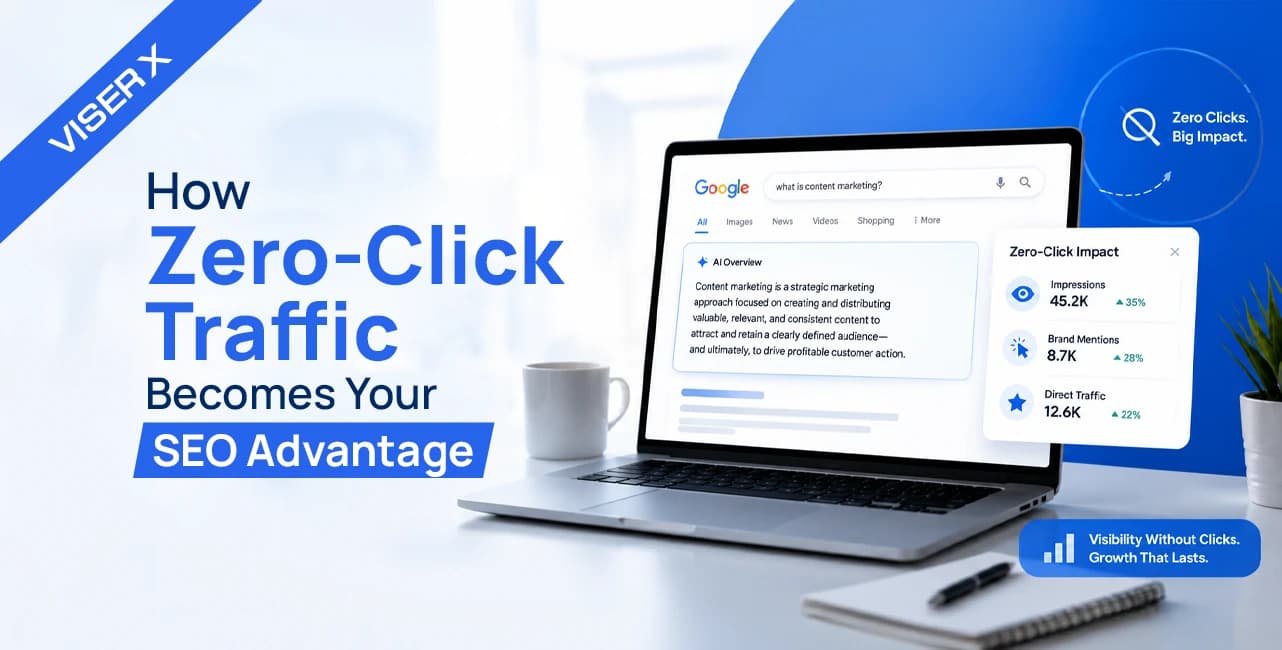


Zero-click traffic becomes an SEO advantage by transforming search engine results pages (SERPs) into brand authority hubs through AI Overviews, Featured Snippets, and Knowledge Panels. When search engines answer queries directly using a brand's data, it captures maximum SERP real estate, builds entity-level trust, and establishes top-of-mind awareness during high-intent user research.
By optimizing for direct-answer extraction, businesses future-proof their Generative Engine Optimization (GEO) strategy, driving higher-converting branded searches and direct traffic when users move from the research phase to a purchase decision.
However, fully leveraging this shift requires understanding why zero-click searches are accelerating and how Google’s evolving SERP features pull information from your content.
Partnering with a digital marketing agency like VISER X ensures your content is structured for both AI citations and high-converting traffic. As search engines transition into answer engines, learning to balance direct visibility with click-worthy depth is no longer optional; it is the baseline for a modern digital strategy backed by expert SEO services.
What Is Zero-Click Traffic (and Why It's Reshaping SEO)
A zero-click search happens when someone gets their answer directly on the results page and never visits a website. Google displays that answer through featured snippets, AI Overviews, knowledge panels, People Also Ask boxes, or a local pack.
The SERP features drive zero clicks
A handful of SERP features account for most zero-click activity:
- Featured snippets: a short answer block pulled from a ranking page and shown above the normal results
- AI Overviews: an AI-generated summary that pulls from several sources at once
- People Also Ask (PAA): expandable questions related to the original search
- Knowledge panels: entity information boxes for people, places, and brands
- Local pack/map pack: business listings shown for "near me" and location-based searches
- Direct answer boxes: quick facts like conversions, dates, and definitions
Each of these features pulls content from a source page, but the searcher rarely needs to visit that page to get value.
How big is the shift, really (verified current data, cited)
The shift toward zero-click searches, where users find answers directly on the search engine results page (SERP) without clicking through to an external website, has accelerated rapidly with the expansion of AI-powered search features like Google AI Overviews.
While numbers vary across methodologies, industry data consistently shows a steep upward trend in zero-click behavior.
The Timeline of the Zero-Click Shift
- 2019 Baseline: Rand Fishkin first quantified in SPARKTORO zero-click searches in a landmark study, revealing that 49% of Google searches resulted in no outgoing click.
- 2024–2025 Benchmarks: Bain’s research, cited by OMNIBOUND AI, found that 80% of consumers now rely on AI-generated results for at least a portion of their search queries.
- 2026 Acceleration: Industry tracking reported by Search Engine Land shows the overall zero-click search rate reaching 68%, driven heavily by the rollout and integration of generative AI across desktop and mobile SERPs.
As search engines transform into answer engines, strategies that focus solely on traditional ranking must adapt to target visibility directly within AI-generated summaries.
Why Zero-Click Isn't a Loss - It's a New Kind of Visibility
Far from losing audience attention, zero-click placements transform search engine results pages into prime branding real estate, delivering immediate impressions and establishing top-of-mind recall at the exact moment of search intent.
Visibility vs. traffic: the metric mindset shift
Traffic counts clicks. Visibility counts exposure. A brand that appears in a featured snippet, an AI Overview, and a PAA box for the same query gets seen three times before anyone clicks anything. That repetition builds brand recall the way a billboard does, except this billboard only shows up when someone is actively searching for what you offer.
That's the core mindset shift behind zero-click SEO. Instead of asking "did this page get a click," ask "did this page get seen by the right person, enough times to be remembered." Impressions, SERP feature ownership, and branded search volume become metrics worth reporting alongside clicks, not instead of them.
Why "cannibalizing your own click" is a fixable formatting problem, not a reason to avoid snippets
A common objection: if your page wins a featured snippet, won't that satisfy the searcher and stop them from clicking through? Sometimes, yes. But the fix isn't avoiding snippets. It's structuring the page so the snippet answers the surface-level question while the rest of the page earns the click for anyone who wants depth, a comparison, or next steps.
Put the direct answer in the first 40 to 60 words, then follow it with the details and data that a snippet can't hold. You win the visibility and keep the door open for the click.
The Business Case: How Zero-Click Presence Builds Real Advantage
Dominating zero-click real estate establishes immediate brand authority at the point of search, driving higher-intent downstream conversions and capturing market share before users ever see a competitor link.
Brand recall and repeat branded search
Every time your brand shows up in an answer box, PAA result, or AI Overview, you're planting a name in the searcher's memory.
Branded search volume, the number of people who later search your company name directly, is one of the clearest downstream signals that zero-click visibility is working. It shows up as direct traffic weeks after the original impression, which is why it gets missed in short-window reporting.
Why AI-referred and post-snippet clicks tend to convert better
When users do click through from conversational AI platforms, the traffic may convert at a substantially higher rate than traditional organic traffic. In a 30-day analysis of its own website, Ahrefs found that AI-search visitors accounted for 0.5% of traffic but generated 12.1% of signups, and reported that they converted at approximately 23× the rate of traditional organic-search visitors.
The reason is simple. A visitor who arrives after reading an AI-generated summary is already pre-qualified. They know roughly what you offer and clicked anyway, which means they want more than the summary gave them. That's a warmer lead than someone who clicked result four out of curiosity.
The compounding citation effect (why one well-structured page keeps getting reused by AI systems)
AI systems don't search fresh every time. They cache and reuse sources that have already proven reliable for a topic. A page that gets cited once for being clear and fact-dense tends to keep getting pulled for related questions, because retrieval systems learn to trust it.
One well-built page can end up feeding dozens of AI answers over time, each one a brand impression that never shows up in click data but keeps compounding in the background.
A Decision Framework: When to Fight for the Click vs. Optimize for Zero-Click
Not every keyword deserves the same treatment. Some are worth chasing purely for visibility. Others still need to be written to win the click, because the click is the entire point.
|
|
|
|
|
|
|
|
|
|
|
|
|
|
|
|
|
|
|
|
|
|
|
|
|
|
|
|
Query types that should chase visibility, not clicks
Informational queries, glossary-style questions, and quick-fact searches are natural zero-click territory. Forcing a click out of someone who just wants to know "what is AEO" usually backfires: they bounce immediately, which hurts engagement signals more than losing the click ever would.
Query types that still need traditional CTR-focused writing
Commercial and transactional queries are different. Anyone searching "best digital marketing agency for ecommerce" or "SEO agency pricing" wants to compare and eventually decide. These pages still need a strong meta description, a compelling title, and a reason to click that a snippet can't satisfy.
How to Structure Content to Win Zero-Click SERP Features
Capturing zero-click SERP features relies on solid technical SEO and on organizing information with clear, scan-friendly HTML elements, such as concise definition paragraphs, ordered lists, and clean data tables.
Writing 40-60-word answer blocks for featured snippets
Place a tight, direct answer right under the H1 or a relevant H2, in the 40 to 60-word range Google tends to pull for snippets. Answer the question in the first sentence, then save the explanation and examples for later.
Formatting for AI Overviews: front-loaded, fact-dense, citation-worthy
AI Overviews favor content that's easy to lift and reuse. That means specific numbers instead of vague claims, clear attribution when citing a stat, and sections that can stand on their own. Don't bury the useful fact in paragraph three. Put it first, then build the story around it.
Winning People Also Ask with question-based subheadings
Structure H3s as the actual questions people type, not clever rephrasing. "How do I optimize for featured snippets" outperforms "Snippet optimization tips" for PAA matching, because Google pattern-matches your heading against real query language.
Schema markup checklist (FAQ, HowTo, Article)
Implementing schema markup doesn't guarantee an immediate ranking boost on its own, but it helps search engines and AI crawlers parse your content more accurately, with modern AI engines relying on structured data more directly than ever. At minimum:
- Article schema: identifies author, publisher, and publish date
- FAQ schema: marks up your FAQ section for direct SERP display
- HowTo schema: structures step-by-step content for process queries
- Organization schema: defines your business as a recognized entity
Building the E-E-A-T That Gets You Cited (Not Just Ranked)
Earning citations from both AI search engines and traditional platforms demands establishing undeniable subject-matter authority through primary research, verified author credentials, and clear factual consensus.
Original data and first-party research as a citation magnet
AI systems and Google both favor content that adds something the internet doesn't already have.
Original research, a proprietary framework, or first-party data from your own client work gives AI engines and readers a reason to cite you specifically instead of paraphrasing a competitor. One strong, clearly sourced data point tends to outperform a page full of generic advice that reads like ten other articles.
Author credentials and structured author schema
A named author with real credentials, linked through Article and Person schema, signals expertise in a way an anonymous "posted by admin" byline never will.
This matters more now than it did a few years ago, since both Google's E-E-A-T guidelines and AI retrieval systems weigh authorship as a genuine trust signal.
Measuring Zero-Click Success: The Metrics That Actually Matter
Tracking zero-click performance requires shifting focus from traditional traffic acquisition to brand visibility, search share of voice, and direct downstream actions across digital touchpoints.
The four metrics to replace CTR-only reporting
Relying on click-through rate alone to judge SEO performance misses most of the value zero-click visibility creates. Track these instead, alongside CTR, not in place of it:
- Impressions and average position (Google Search Console): shows how often you're being seen, even without a click
- SERP feature ownership: how many featured snippets, PAA boxes, and AI Overview citations you hold for target keywords
- Branded search volume growth: a lagging but reliable signal that visibility is turning into recognition
- Direct traffic and assisted conversions (GA4): captures people who saw you in a zero-click result and came back later through a different channel
A simple client-reporting reframe for agencies
Clients who look only at session counts will see a scary chart once zero-click search eats into their clicks.
You need to reframe the report before they ask why traffic dropped. Show impressions alongside clicks. Show SERP feature wins as a separate line item. Finally, show branded search growth as evidence that visibility is converting into recognition. A client might lose 20% of their sessions.
However, if they gain snippet ownership and rising branded search, they are usually in a stronger position. The report should say so plainly.
Zero-Click SEO in Practice: A Quick Self-Audit Checklist
Run through this before your next content sprint.
- Does every page have a 40-60 word direct answer under the H1 and each major H2?
- Are your H3s written as actual questions that match how people search?
- Is the FAQ, Article, or How-To schema implemented where relevant?
- Do your highest-traffic pages have a named author with linked credentials?
- Are you tracking impressions, SERP feature wins, and branded search, not just clicks?
- Have you identified which of your keywords should chase visibility versus which need to win the click?
- Is your Google Business Profile fully optimized through dedicated Local SEO services to secure maximum local pack visibility
Final Thoughts: Treat Zero-Click as Presence, Not a Penalty
Zero-click search isn't a glitch in the system. It is where search is headed, and it isn't slowing down.
Businesses that report only on clicks will keep telling a story that looks worse every quarter. The smart ones build for visibility instead. They structure content for extraction and track the right metrics.
As a result, they show up everywhere their buyers ask questions. This happens whether it turns into an immediate click or a branded search three weeks later.
This is the strategy shift VISER X builds into every SEO and GEO engagement. We create content that wins the snippet and earns the AI citation. That same content still converts when the click finally comes. If your current SEO reporting tells only half the story, it might be time for an in-depth SEO audit to reveal the other half.
Frequently Asked Questions
What is zero-click traffic?
Zero-click traffic refers to search results in which the user finds their answer directly on the SERP via a featured snippet, AI Overview, knowledge panel, or similar feature, without clicking through to a website.
Is zero-click traffic bad for my website's SEO?
Not inherently. It reduces raw click volume but increases brand visibility, and pages that win zero-click features often build the trust and recognition that drive clicks later.
How do I optimize content for featured snippets?
Place a direct, 40-60-word answer right after the relevant heading, use clear formatting like lists or short paragraphs, and match your subheadings to how people actually phrase questions.
Does voice search affect zero-click traffic?
Yes. Voice assistants read out the same featured snippets and direct answers that power zero-click results, so voice search optimization and zero-click SEO rely on the same content structure.
Can I actually track zero-click performance?
Yes. Google Search Console shows impressions and average position, and pairing that with GA4 direct traffic and branded search volume gives a reliable picture of zero-click impact.
What's the difference between SEO and AEO (Answer Engine Optimization)?
SEO focuses on ranking pages in traditional search results to earn clicks. AEO focuses on structuring content so that AI-powered answer engines can extract and cite it directly, often without a click.
What percentage of Google searches end without a click?
Current estimates for 2026 range from roughly 60% to 68% of all Google searches, with mobile search and AI Overview queries pushing that figure higher