Generative Engine Optimization (GEO): What It Is and How to Do It
- Post By: FAISAL MUSTAFA
- Published: July 17, 2026
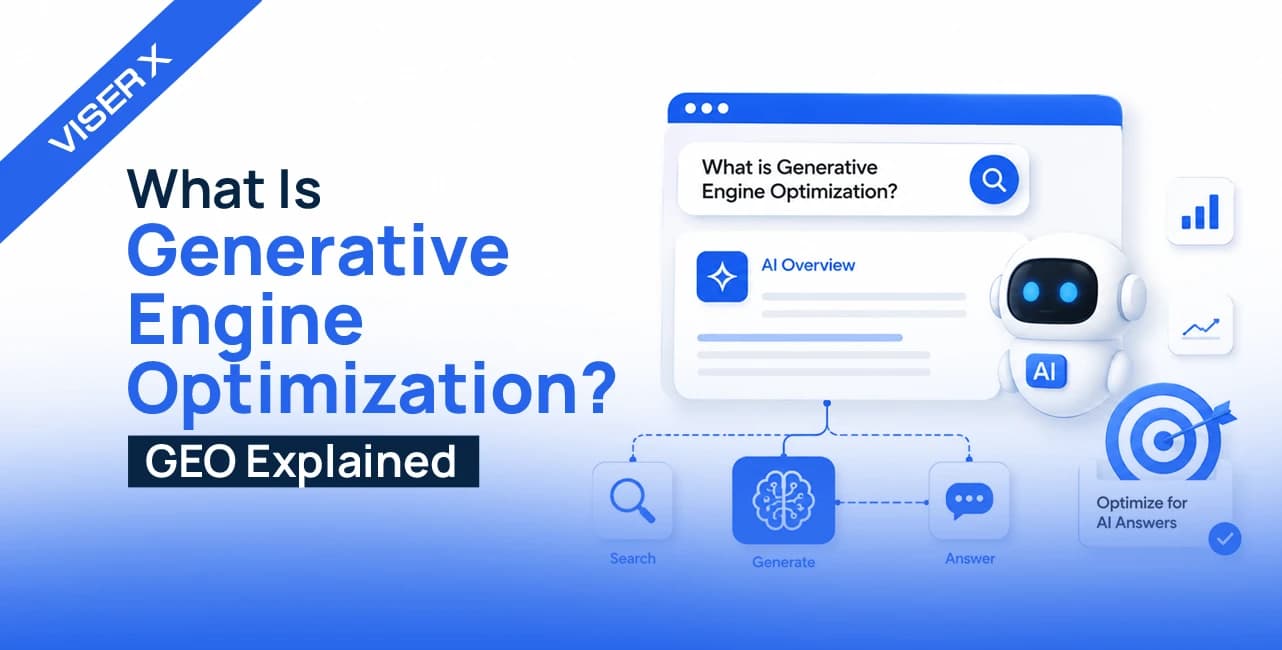


Artificial intelligence is changing how people search for information online. Instead of clicking through multiple websites, many users now ask tools like ChatGPT, Google AI Overviews, Perplexity, Gemini, and Claude to get direct answers.
These AI-powered search experiences summarize information from trusted sources and present it instantly, reducing the need for traditional search results.
This shift has created a new challenge for businesses. Ranking on Google is still important, but it is no longer enough. Your content also needs to be visible, understandable, and trustworthy enough for AI systems to reference, summarize, and cite. That is where generative engine optimization comes in.
So, what is generative engine optimization?
It is the process of optimizing your website and content, so AI-powered search engines and large language models (LLMs) can easily discover, understand, and mention your brand in their responses.
Millions of users also rely on ChatGPT, Perplexity, and other AI assistants every day to research products, compare services, and make buying decisions.
As AI becomes part of everyday search behavior, businesses that optimize only for traditional SEO risk losing valuable visibility. According to Google, AI-powered search features help users ask more complex questions and discover information in new ways, making high-quality, trustworthy content more important than ever.
But GEO does not replace SEO, it builds on it. Strong technical SEO, helpful content, and authority remain essential.
However, successful AI search optimization also requires structured content, clear answers, strong brand signals, and content that AI systems can confidently extract and cite.
This blog breaks down exactly what GEO is, how it's different from traditional SEO, and the concrete steps to start earning those citations.
What Is Generative Engine Optimization?

Generative engine optimization (GEO) is the practice of shaping your content so AI tools like ChatGPT, Perplexity, Gemini, and Google AI Overviews can find it, understand it, and quote it in their answers. It's the discipline of writing and structuring your website so a machine chooses you, not just so a human clicks you.
The term comes from a 2023 research paper by scientists at Princeton University, Georgia Tech, and the Allen Institute for AI. They tested nine content techniques across 10,000 real queries and found that targeted optimization can lift a page's visibility inside AI answers by up to 40 percent.
In simple terms, SEO helps you rank on a results page. GEO helps you get chosen as the answer. This is also why you'll see GEO called AEO (answer engine optimization) or LLM SEO in different blogs.
They all describe the same goal, earning a spot inside an AI-generated response instead of just a spot on a search results page.
GEO vs. SEO: What's the Difference?
Generative engine optimization vs SEO isn't really a fight between two rival strategies. It's closer to a relationship between a foundation and the structure built on top of it, one that only works if the foundation is solid first.

How GEO and SEO are Similar
Both disciplines depend on the same core ingredients, and neglecting either one leaves the other weaker. If you're strong in SEO but ignore GEO, you'll keep ranking while quietly losing ground in AI answers.
- Genuine expertise and trustworthy content
- Clean technical setup so crawlers, human or AI, can actually access your pages
- Strong topical coverage of your subject, not just one keyword-stuffed page
- Backlinks and brand mentions, which still tell AI systems who to trust
Most AI tools use a method called retrieval-augmented generation, or RAG, which means they still pull from indexed, ranked web pages before writing an answer. If your site barely shows up in Google, it's unlikely to show up in ChatGPT either. GEO doesn't replace SEO, it builds on it.
How GEO and SEO are Different
Where the two disciplines really split is in what counts as success. SEO chases a ranking position. GEO chases a mention, whether or not that mention comes with a click.
|
|
|
|
|
|
|
|
|
|
|
|
|
|
|
|
|
|
|
|
|
|
|
|
The biggest practical difference is what counts as a "win." A user can read your stat inside a ChatGPT answer, never click through, and still walk away trusting your brand. That's a GEO win even with zero traffic.
Why Does GEO Matter Right Now?
Search is genuinely changing shape, and the numbers back it up. This isn't a future trend to plan for someday, it's already reshaping how much traffic reaches your website this year.
Google's AI Overviews now show up in roughly 1 in 6 US searches, more than double the rate seen a year earlier, with informational queries the most affected. When an AI Overview appears above the normal results, the page in the top organic spot loses a large share of the clicks it used to get, because the searcher already has an answer.
Zero-click behavior isn't limited to Google either. Analysts project a meaningful share of organic search traffic will move to AI chatbots and voice assistants within the next couple of years, a trend our guide to AI and SEO breaks down in detail.
None of this means traditional search is dying. Google still handles far more daily queries than any AI chatbot. But the businesses winning right now are the ones showing up in both places, not choosing one over the other.
How Do Generative Engines Actually Work?
Before you optimize for something, it helps to know exactly how it makes decisions. Generative engines aren't magic, they follow a fairly logical three-step process every time someone asks a question.
Most generative engines follow these steps:
- Retrieve: The AI searches the web (or its own index) for pages relevant to the question, similar to a normal search engine.
- Rank and select: It picks a handful of the most trustworthy, clear, and relevant sources from that pool.
- Generate: It writes a new answer in its own words, pulling facts, stats, and phrasing from those selected sources, sometimes with a citation link, sometimes without.
This is why a page that's invisible to Google is almost always invisible to AI too, it never makes it into step one. It's also why clarity matters so much in step two. If your page is vague or hard to parse, the model skips it for a competitor's cleaner answer, even if your content is technically more accurate.
Core Generative Engine Optimization Strategies
Here's what actually moves the needle, based on both the Princeton research and what we've seen work firsthand for real client sites. None of these requires a total rebuild, but they do require consistency.
Structure Content for Extractability
AI systems favor content they can lift out cleanly, without needing to rewrite it from scratch first. The easier you make a fact to isolate, the more likely a model reuses it word for word.
- Answer the core question in the first 40 to 60 words of a section, then explain further
- Use descriptive H2/H3 headings phrased the way people actually ask questions
- Break long paragraphs into short ones, 2 to 4 sentences each
- Use bullet points and comparison tables for anything with multiple parts
You can check our blog on different types of technical writing for business growth, here we cover that a clear structure isn't just good writing, it's what makes information machine-readable.
Build Genuine Authority and E-E-A-T Signals
Google's E-E-A-T framework, experience, expertise, authoritativeness, trust, matters just as much to AI systems as it does to search rankings. AI can summarize existing knowledge fluently, but it cannot invent your firsthand experience, and that gap is exactly where you should be building.
- Naming a real author with real credentials on important pages
- Sharing first-hand experience, case studies, and original data, not just summarized advice
- Keeping claims accurate, so nothing you publish gets flagged as unreliable later
Content that reads like it was written by someone who has actually done the work tends to earn citations that generic, rehashed advice never will.
Earn Citations and Brand Mentions Across the Web
Most of the mentions of AI tools used about a brand don't come from that brand's own website. They come from third-party sources, review sites, forums, roundup articles, and press coverage, which means your own blog is only one piece of the puzzle.
- Get featured in relevant "best of" and comparison lists in your industry
- Encourage detailed customer reviews (specific ones, not just star ratings)
- Pursue digital PR and guest contributions on reputable industry sites
- Show up in active, honest discussions on Reddit and niche forums, since both are heavily cited by AI Overviews and chatbots
Unlike classic link building, these mentions don't even need a hyperlink to count. AI models can recognize and use an unlinked brand mentioned just as easily.
Keep Content Fresh and Technically Accessible
AI systems tend to favor recently updated content over older pages, even when the older page still ranks well in classic search. A guide that hasn't been touched in two years quietly loses ground to a fresher competitor covering the same topic.
- Review and refresh your core content on a regular schedule, not just once and forget it
- Make sure AI crawlers, like GPTBot and PerplexityBot, aren't blocked in robots.txt
- Keep critical content in plain HTML, not buried inside heavy JavaScript
- Maintain fast load times and mobile-friendly design
Freshness signals are cheap to fix and easy to overlook, which makes them one of the highest-leverage items on this list.
Implement Structured Data and Schema Markup
Schema is essentially a translator that tells machines exactly what your content means, not just what it says. It removes the guesswork a model would otherwise need to do on its own.
- FAQ schema for question-and-answer sections
- Article and Author schema for blog content
- Organization and Product schema so AI can confirm exactly who you are
This is one of the fastest, purely technical wins available, and it pairs directly with the content-writing techniques discussed in our post on using AI for SEO content writing.
Platform-Specific Considerations: ChatGPT, Perplexity, Google AI Overviews & Others
Not every generative engine works exactly the same way, so how to rank in ChatGPT isn't identical to ranking in Perplexity or Google's AI Overviews. Treating them as one single target usually means underperforming on all of them.
- Google AI Overviews pull heavily from pages that already rank well organically, and reward clear, well-structured on-page content with strong schema.
- ChatGPT (when browsing) leans on real-time web search plus its training data, so consistent, accurate brand information across many websites over time matters more than a single perfectly optimized page.
- Perplexity favors citation-dense answers and tends to link back to sources more visibly than other tools, making it one of the more "SEO-friendly" generative engines to track.
- Voice assistants and AI Mode favor short, conversational answers, similar to what we outline in our guide to voice search optimization, since many of the same natural-language principles apply.
The best approach is to create clear, trustworthy, and well-structured content that works for all AI search platforms. Instead of trying to optimize for just one AI engine, focus on helping both users and AI understand your content easily.
Common GEO Mistakes to Avoid
Most GEO failures aren't dramatic, they're small, avoidable habits that quietly cap your visibility.
Here are the ones we see most often when auditing sites for the first time.
- Chasing AI rankings while ignoring SEO basics: If your technical SEO and content depth are weak, GEO tactics alone won't fix it.
- Writing vague, marketing-heavy copy: AI systems are trained to prefer specific, factual statements over promotional language.
- Ignoring third-party mentions: Focusing only on your own website misses where most AI citations actually originate.
- Letting content go stale: A great guide from two years ago, never updated, quietly loses ground to a fresher competitor.
- Blocking AI crawlers by accident: Some sites unknowingly disallow AI bots in robots.txt while trying to block scrapers.
- Treating GEO as a one-time project. Like SEO, it needs ongoing measurement and iteration, not a single setup pass.
How to Measure GEO Performance
Traditional rank tracking alone won't tell the full story anymore, since a page can lose clicks while gaining valuable AI mentions at the same time. You need a slightly wider set of metrics to see the real picture.
- AI mentions: How often your brand appears in AI answers, with or without a link. You can check this manually by running your top industry questions through ChatGPT, Perplexity, and Gemini regularly.
- AI citations: Specific instances where your content is directly referenced or linked as a source.
- Referral traffic from AI platforms: Most analytics platforms, including Google Analytics 4, now let you segment traffic coming from AI assistants.
- Branded search volume: A rising trend here often signals your AI visibility is working, since people who saw your name in an AI answer often go search for it directly afterward.
- Conversion rate from AI-referred visits: This traffic tends to convert at a higher rate than average organic traffic, because the visitor already has context before they land on your site.
A handful of specialized platforms track AI share of voice at scale, but for most businesses, a consistent manual audit combined with GA4 segmentation gets you 80 percent of the insight at a fraction of the cost.
As Contentful's own research on GEO measurement points out, there's still no single, unified metric for AI visibility the way there is for search rankings, so most brands are best served by tracking a blend of the signals above rather than waiting for one perfect dashboard.
How VISER X Approaches Generative Engine Optimization
At VISER X, we treat GEO as an extension of solid SEO, not a replacement for it. Businesses that hire us aren't choosing between ranking in Google or being cited by AI, they're building visibility across both at once.
As a GEO agency, our approach to generative engine optimization strategies combines four things most agencies still overlook:
- Technical foundations first: We audit crawlability, schema, and site speed before touching content, since none of the rest matters if AI bots can't reach your pages.
- Structured, answer-first content: Every page we build is written to directly answer the question in the first few sentences, then supported with depth.
- Brand mention building across the web: not just backlinks, so your name shows up in the reviews, forums, and roundups AI tools actually cite.
- Ongoing measurement: tracking AI mentions and citations the same way we track rankings, so strategy adjusts as platforms evolve.
Our GEO services are built for businesses that want to stay visible whether a customer searches on Google, asks ChatGPT, or gets a voice answer from their phone.
If you want a clearer picture of where your brand currently stands in AI answers, that's exactly the kind of audit our team runs first.
Getting Started With GEO
You don't need to overhaul your entire content strategy overnight, and trying to fix everything at once usually stalls before it starts. A focused first month beats a scattered first year.
- Audit your top 10 highest-traffic pages for clarity, structure, and freshness
- Add FAQ schema to your most important service and blog pages
- Run your five most valuable customer questions through ChatGPT and Perplexity to see who gets cited instead of you
- Pitch a handful of relevant "best of" lists or review platforms in your industry
- Set a quarterly refresh schedule for your cornerstone content
Generative engine optimization rewards the same qualities that have always mattered, those are clarity, honesty, and real expertise. AI just changed who's reading it first.
Some Common FAQs on Generative Engine Optimization (GEO)
01. Is GEO replacing SEO?
No. GEO works alongside SEO, not instead of it. Most AI tools retrieve information from the same indexed web that Google search ranks, so a weak SEO foundation limits GEO results too. Think of GEO as an additional layer of optimization, not a replacement strategy.
02. What's the difference between GEO, AEO, and SGE?
GEO (generative engine optimization) and AEO (answer engine optimization) are largely used interchangeably to describe optimizing for AI-generated answers across platforms like ChatGPT and Perplexity. SGE, or Search Generative Experience, was Google's earlier name for its AI-powered search feature, which has since evolved into AI Overviews and AI Mode. In short: GEO and AEO describe the strategy, SGE described one specific Google product.
03. Are there risks to generative engine optimization?
Yes, a few worth knowing. AI models can occasionally misquote or misattribute content, and there's still no single, unified way to measure GEO performance across every platform. Over-optimizing purely for AI citation at the expense of genuine user value can also backfire, since these platforms are getting better at detecting manipulative content over time.
04. How do I get started with GEO?
Start with a technical and content audit: confirm AI crawlers can access your site, add schema markup to key pages, and rewrite your most important content to answer questions directly in the first few sentences. Then work outward, building brand mentions across reviews, forums, and industry publications.
05. What tools help track GEO performance?
Google Analytics 4 (for AI referral traffic segmentation), Google Search Console (for impression trends), and manual prompt testing across ChatGPT, Perplexity, and Gemini are a solid free starting point. Several paid platforms also track AI share of voice and citation frequency at scale for larger brands