Entity SEO for Brands: Build Your Authority in the AI Era
- Post By: FAISAL MUSTAFA
- Published: August 19, 2026
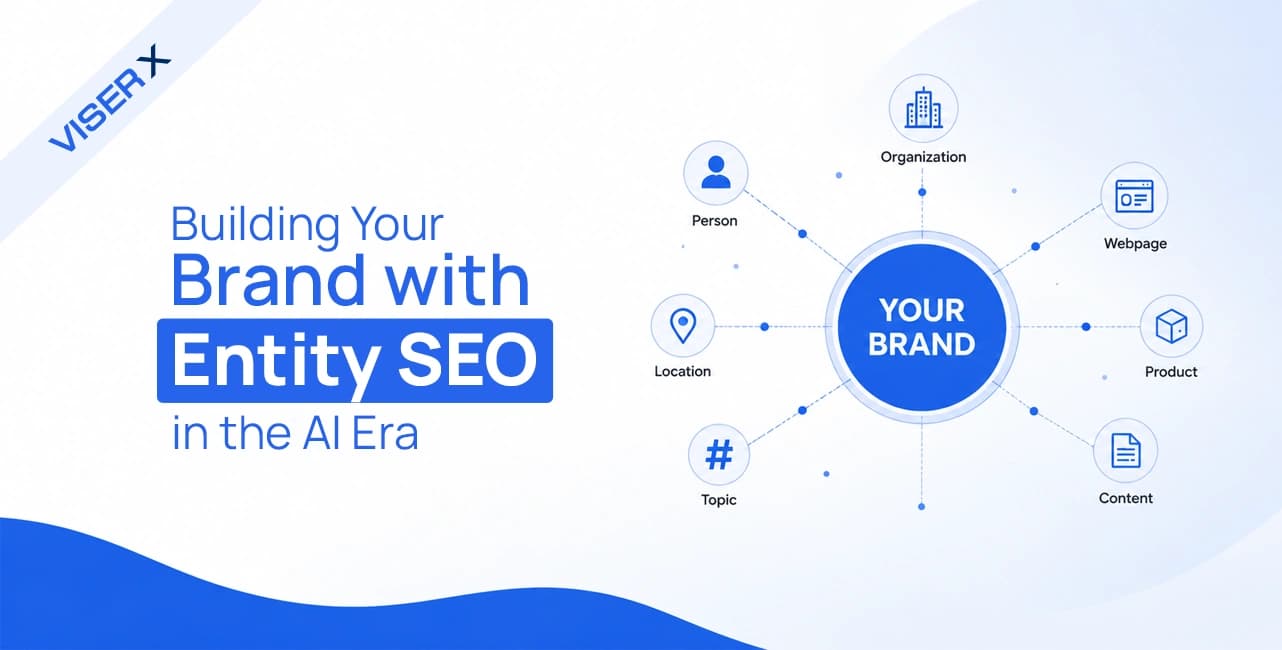


Entity SEO for brands starts with one shift in thinking. Search engines have changed from keyword matchers into what Google's own AI Overview now calls "reality engines."
These engines map real-world concepts, people, products, and businesses. The mapped elements are called entities.
That shift changes what "ranking" means. A page can rank for a keyword. But an AI system may still ignore that page if it doesn't recognize your brand as a verified, authoritative entity.
To build your brand today, you need to pivot from traditional keyword optimization to entity SEO. This blog breaks down what entity SEO actually is. It shows why entity SEO matters more in 2026 than it did a year ago.
And it gives you a practical, step-by-step framework to build your brand as an entity that Google, ChatGPT, Perplexity, and Google's AI Overviews all recognize and trust.
What Is Entity SEO (and How Is It Different from Keyword SEO)?
Entity SEO helps search engines and AI models understand your brand as a real, well-defined "thing." It is not just a collection of keywords on a page. Instead of optimizing for what people type, you optimize for what your brand actually is and how it connects to other people, places, and topics.
This matters because keyword SEO and entity SEO solve different problems. Keyword SEO asks "which words will match this search?" Entity SEO asks "does this system already know who I am?" A brand can win the first question and still lose the second.
Strings vs. Things
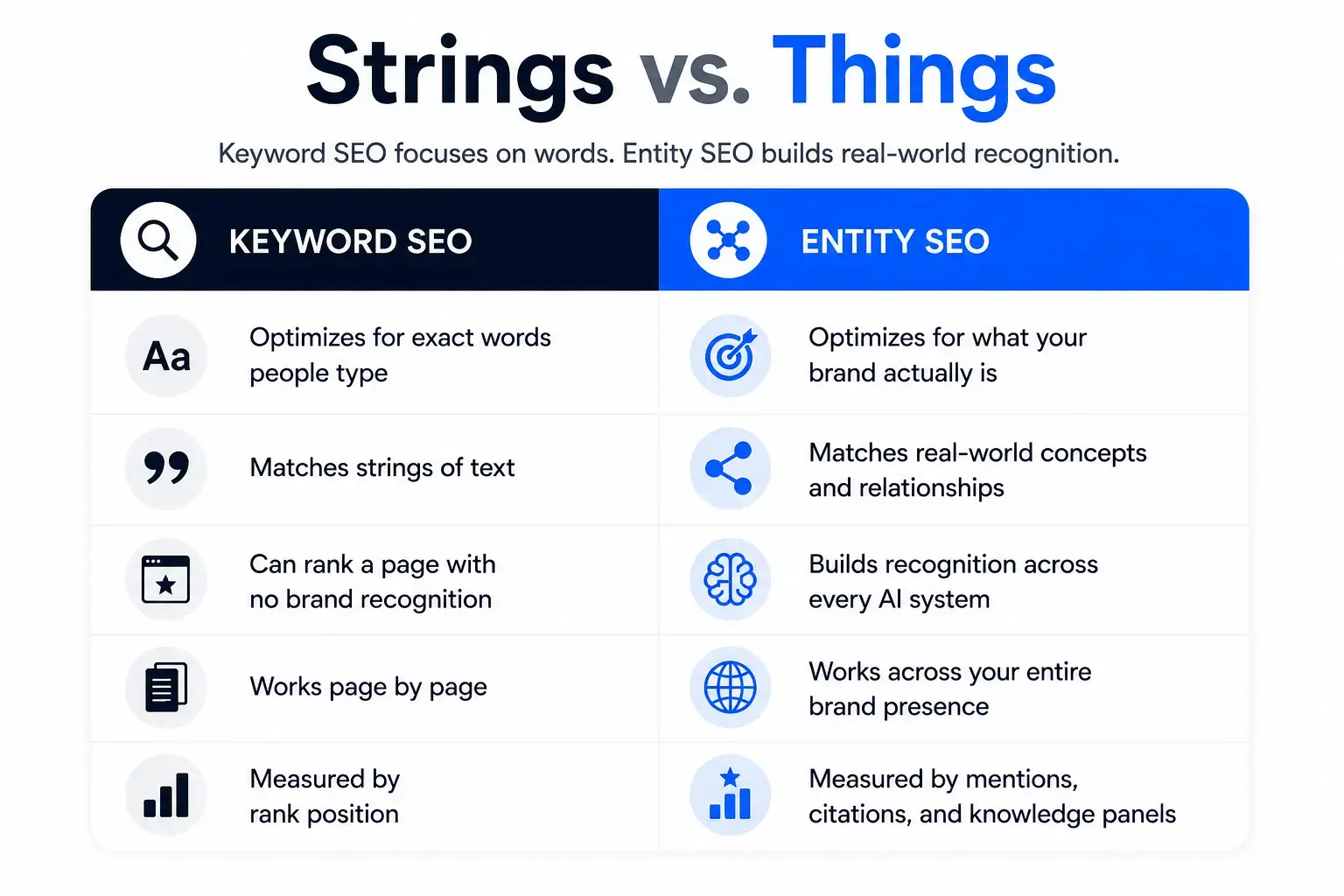
Google describes an entity as a thing that is singular, unique, well-defined, and distinguishable. A string is just a sequence of letters. A thing is a real concept with a fixed identity.
The table below makes the difference concrete. It's worth keeping close, because every decision in this blog traces back to one column or the other.
|
|
|
|
|
|
|
|
|
|
|
|
|
|
|
|
|
|
For Example: Take the word "Apple." As a string, it could mean a fruit, a record label, or a technology company. As an entity, Apple Inc. is a specific company with a known founding date, known products, and known relationships to people like Steve Jobs and Tim Cook.
Search engines resolve that ambiguity by matching the string to the entity that fits the context!
How Google's Knowledge Graph and AI Models Use Entities
Google's Knowledge Graph is a database of entities and the relationships between them. It's why a search for a well-known company shows a summary box with facts and related entities, instead of just ten blue links.
AI models work differently, but the goal is the same. They don't store neat facts in a database. Instead, they learn patterns from billions of pages and place similar ideas close together in something called a vector space, a method known as dense retrieval.
When your brand is mentioned the same way by many independent sources, it becomes a clearer, stronger point in that space. A clear point is what makes an AI system confident enough to recommend you.
This same shift is already reshaping how local and niche businesses show up in entity-based search results.
Why Entity SEO Matters More Than Ever in 2026
Ranking a page used to be the finish line. In 2026, it's just one input into a bigger decision: whether an AI system trusts your brand enough to cite it, recommend it, or act on it.
AI Overviews and Answer Engines Are Replacing "Ten Blue Links"
Search results now often open with an AI-generated summary before a single traditional link appears. That summary is built from entities the AI already trusts. It is not built from a fresh scan of every page that matches a keyword.
If your brand isn't a recognized entity, you simply don't get pulled into that summary, no matter how well your page is optimized.
We break down how this zero-click shift changes SEO and AEO strategy in more detail.
Brand Authority Is Overtaking Page Authority
A single high-ranking page used to be enough to win traffic. Now, AI systems weigh the credibility of the whole brand behind that page.
A brand with consistent, proven authority across many sources gets cited more often than a brand with one great article and nothing else backing it up.
This is why entity SEO for brands works differently from page-level SEO. You're not optimizing one URL to beat one competitor's URL.
You're building a body of evidence, spread across your site, your social profiles, and independent sources, that proves your brand is a real authority in your niche.
Agentic Search: How AI Agents Choose Which Brands to Act On
Agentic search is the next layer past AI Overviews. This is when an AI agent doesn't just summarize information. It takes action on your behalf: booking a service, comparing vendors, or picking a product to buy.
An agent making that choice can't stop and manually verify every brand it considers. It leans on brands it already recognizes as safe, established entities. An unfamiliar brand is a risk.
The agent has no reason to take that risk when a known, trusted entity is sitting right there instead.
Before an agent recommends or books with a brand, it usually checks for:
- A consistent name and description across every source
- Independent mentions that confirm the brand is real
- Structured data that clearly states what the brand offers
- A track record of accurate, non-contradictory information
This is the clearest reason building your brand with entity SEO in the AI era can't wait. Agentic search rewards brands that were already recognized before the query was ever typed.
The Core Entities Every Brand Needs to Define
Before you can build entity SEO for your brand, you need to know exactly which entities you're building. Most brands only think about their company name and miss the rest of the picture.
Brand and Product Entities
A company is not just one entity. The company itself is an entity. Each major product or service line is also its own entity, connected back to the parent brand through consistent naming. For example:
- The company: your legal brand name and headquarters
- Each product or service line: named and described on its own page
- Each location, if you operate in more than one place
Topic and Niche Entities
These are the subjects your brand wants to be known for. If you run a furniture company, your topic entities might include "solid wood furniture" or "home office design."
Building topical authority through content clusters connects your brand entity to these topic entities in a way search engines and AI models can actually verify.
Semantically Related Entities
Semantic search works by understanding meaning, not just matching words. Semantically related entities are the people, places, tools, and concepts that naturally connect to your core topic.
A digital marketing agency's related entities might include specific services like SEO, PPC, and content marketing, plus the tools and industry terms tied to that work.
Mentioning these related entities in context, naturally, helps AI models place your brand correctly inside the bigger picture of your industry.
A Step-by-Step Framework for Building Your Brand as an Entity
Knowing the theory isn't enough!
Building a dominant brand entity relies on three critical pillars, described as the Code, Content, and Contextual Linking framework. Google's own AI Overview organizes this same work into three layers: technical foundation, topical entity, and corroboration.
Each layer builds on the one before it. Skipping a layer weakens everything you build on top of it.
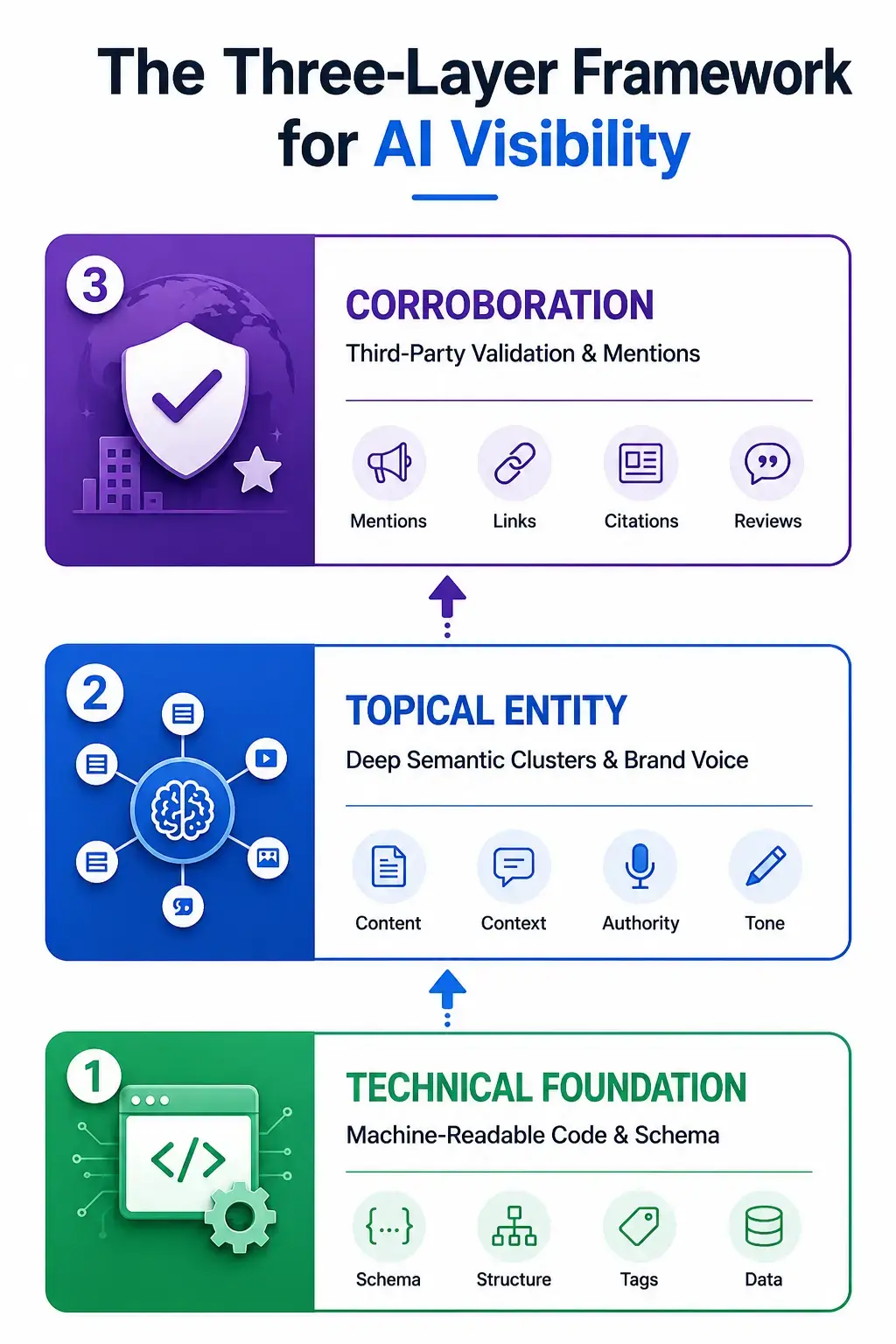
Here's the practical, six-step framework we use to turn a brand into a recognized entity.
The six steps below fit neatly inside these three layers, moving from the ground up.
|
|
|
|
|
|
|
|
|
|
|
|
|
|
|
|
|
|
|
|
|
|
|
|
|
|
|
|
|
|
|
|
|
|
|
Step 1: Define Your Core Entity and Sub-Entities
Write down your brand's exact legal name, your one-line description of what you do, and your primary category. Then list every product, service, and location as a sub-entity connected to that core identity.
This sounds basic, but most brands have never written it down in one place. Without it, every other step in this framework has nothing solid to build on.
Step 2: Audit Your Current Entity Presence
Search your brand name and check what shows up: your website, your social profiles, directory listings, and any news mentions. Look for mismatched names, outdated descriptions, or conflicting details across these sources.
This is where brand consistency and NAP consistency (name, address, phone) come in. Every inconsistency you find is a signal that confuses search engines about who you actually are.
Step 3: Implement Entity-Specific Schema Markup
Schema markup for entity SEO tells search engines exactly what your brand represents, in a format machines can read directly instead of guessing. At minimum, use Organization schema with:
- Your official brand name
- Your logo
- A clear, accurate description
- A sameAs field linking to your verified social profiles and Wikidata entry, if you have one
This structured data is one of the fastest ways to strengthen AI search brand visibility, because it removes the guesswork for both search engines and AI crawlers.
Step 4: Build Topic Clusters and Pillar Content Around Your Entity
Publish one strong pillar page on your core topic. Support it with cluster content covering related subtopics in depth. Link these pages to each other naturally, so the relationship between them is obvious to readers and search engines alike.
A single article on a topic says little. Twenty connected, in-depth articles on the same topic say a great deal.
Step 5: Earn Entity Mentions, Co-Citations, and Backlinks
A co-citation happens when your brand is mentioned alongside other respected names in your industry, even without a link. Both linked and unlinked mentions add up as evidence that your brand belongs in that conversation.
Do backlinks still matter if you're focusing on entity SEO? Yes. Backlinks remain a strong trust signal for AI systems, especially from sites already recognized as authorities in your niche. Entity SEO doesn't replace backlinks. It adds unlinked mentions and co-citations as a second, equally important layer of proof.
Step 6: Strengthen E-E-A-T and Author Entities
E-E-A-T (Experience, Expertise, Authoritativeness, Trustworthiness) applies to your brand as a whole, and to the people who create your content. Give your writers real author bios, credentials, and consistent bylines across everything they publish.
When an author becomes a recognized entity in their own right, that credibility flows back to your brand entity too.
This matters most for YMYL (Your Money or Your Life) topics like finance, health, and law, where AI systems apply a higher trust bar before citing anything.
Measuring Entity SEO Success (Beyond Keyword Rankings)
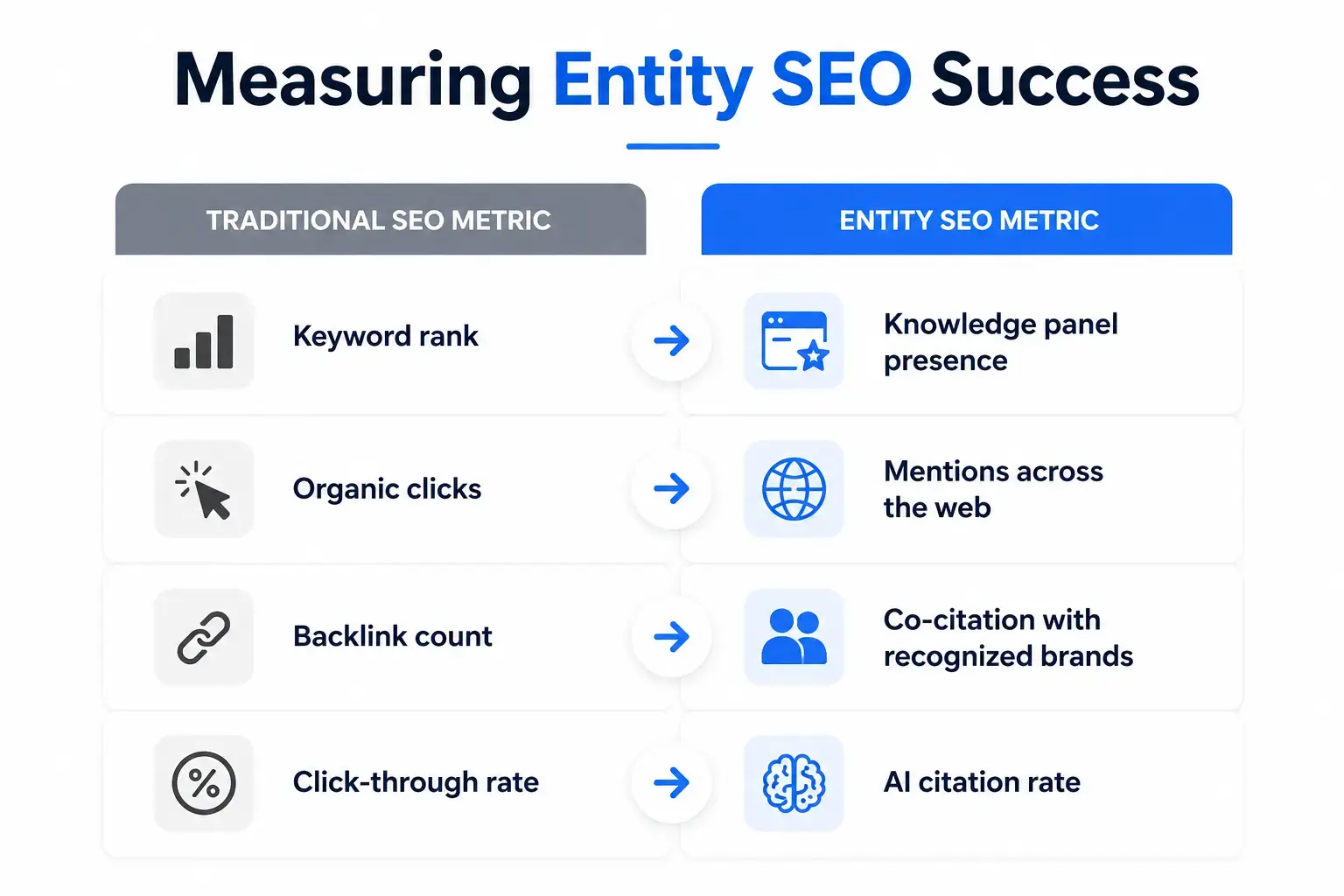
Keyword rank reports won't show whether your entity's SEO work is paying off.
You need a different set of metrics, built around recognition and citation, not just position.
|
|
|
|
|
|
|
|
|
|
|
|
|
|
|
Knowledge Graph and Knowledge Panel Presence
Search your brand name and check whether a knowledge panel appears. This is one of the clearest signs that Google has recognized your brand as a distinct, verified entity, not just another website.
Entity Mention Frequency and Co-Citation Tracking
Track how often your brand gets mentioned across news sites, blogs, and industry publications, with or without a link back. Rising mention frequency, especially alongside established names in your space, shows your entity footprint is growing.
AI Citation Rate as a New Core KPI
AI citation rate measures how often tools like ChatGPT, Perplexity, and Google AI Overviews mention or recommend your brand when someone asks a relevant question.
This is quickly becoming as important as organic rank, because it reflects whether AI models trust you enough to recommend you directly.
Reviewing core SEO benchmarks alongside this newer metric gives you a full picture of both traditional and AI-driven performance.
Common Entity SEO Mistakes That Undermine Brand Trust
Even brands that understand entity SEO in theory often undercut their own progress with a few avoidable mistakes.
Inconsistent Brand Signals Across Platforms
Consistency sounds small, but it's one of the most common reasons brands stay invisible to AI systems. It usually shows up in two ways.
- Different names or descriptions across platforms confuse AI models: If your website calls you "VISER X Digital Agency" and your LinkedIn page says "VISERX Marketing," that mismatch forces search engines to guess whether these are the same entity.
- Outdated directory listings quietly damage trust. An old address, a disconnected phone number, or a former business name still floating around online is exactly the kind of noise that weakens entity recognition over time.
Treating Schema as a Checkbox, Not a Relationship Map
Schema markup only works if it reflects real relationships, not just default fields. Two habits quietly undercut brand trust here.
- Copy-pasted schema without real detail doesn't help: Generic Organization schema with no “sameAs” links, no accurate category, and no real description is barely better than having none at all.
- Schema should map real relationships, not just check a box: The goal is to show how your brand, products, authors, and related topics connect, the same way structured data continues to evolve as search engines refine what they reward.
The Future of Entity SEO in the AI Era
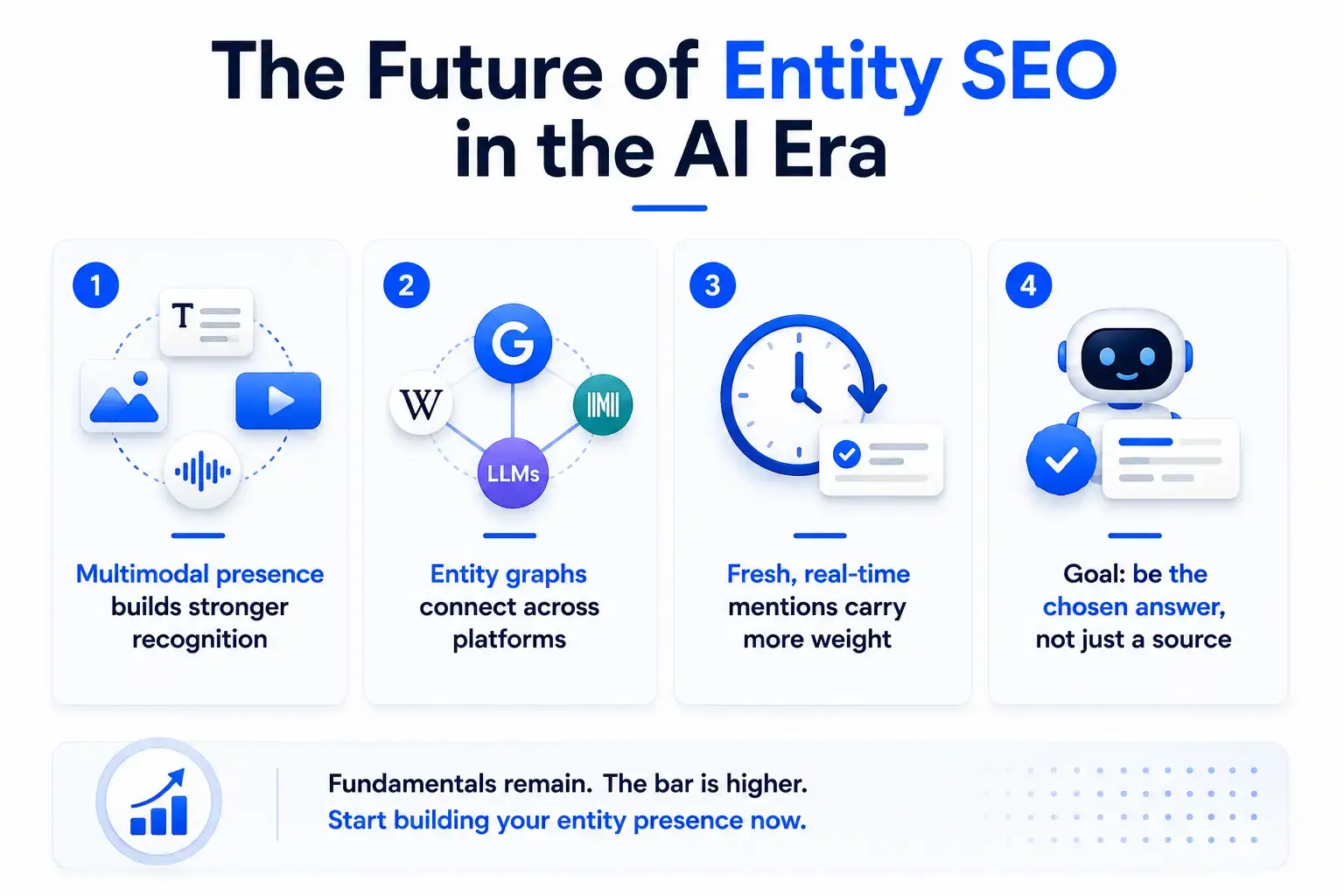
Entity SEO isn't standing still. AI models keep getting better at understanding context, and that raises the bar for what counts as a "recognized" brand. A few clear shifts are already shaping where this is headed.
- Multimodal entities matter more: AI models now connect your brand across text, images, video, and voice, not just written pages. A brand known only through blog posts is weaker than a brand people also recognize from videos, podcasts, or images.
- Entity graphs are merging across platforms: Google's Knowledge Graph, Wikidata, and the training data behind large language models (LLMs) increasingly reference each other. A strong presence in one place makes it easier to build a strong presence in the others.
- Real-time corroboration is starting to carry more weight: AI systems update faster than they used to, so stale mentions and outdated details lose value quickly. Fresh, ongoing mentions are becoming more valuable than a single big PR win from years ago.
- Brands are starting to compete to be the answer, not just a source: As agentic search grows, the goal shifts. It is no longer enough to be cited. Brands need to be the one an AI agent actually chooses and acts on.
None of this replaces the fundamentals covered in this blog. It simply raises the ceiling on what a strong entity presence can achieve, and it rewards brands that start building now instead of waiting.
Final Thoughts
Entity SEO is not a quick fix. It doesn't work like a keyword you insert once and rank for overnight.
Building your brand with entity SEO in the AI era takes real, consistent effort. It means fixing inconsistent details across every platform you use. It means adding proper schema. It means earning mentions from real, independent sources over time.
The reward is worth it. Once your brand becomes a recognized entity, you stop chasing individual keywords. You start showing up automatically, in AI Overviews, knowledge panels, and the answers AI agents give when someone asks who to trust in your industry.
Start with the three layers Google itself surfaces for this topic. Get your technical foundation right, build out your topical entity, then earn corroboration.
If you want hands-on help turning this framework into results, VISER X's SEO team can build and manage entity SEO for your brand.
Most Common FAQs on Building Your Brand with Entity SEO in the AI Era
1. What is entity SEO in simple terms?
Entity SEO means helping search engines and AI models understand your brand as a real, specific "thing," not just a set of keywords. Instead of chasing exact-match phrases, you build a clear, consistent picture of who you are and how you connect to your industry. This helps you show up in knowledge panels, AI Overviews, and AI-generated answers, not just traditional search rankings.
2. How is entity SEO different from traditional/keyword SEO?
Keyword SEO optimizes for the exact words people type into a search bar. Entity SEO optimizes for the meaning and relationships behind those words, so AI systems recognize your brand even when someone phrases a question differently. The two work together, but entity SEO is what makes your brand recognizable across many different queries, not just one exact phrase.
3. Can small businesses benefit from entity SEO, or is it only for large brands?
Small businesses can absolutely benefit and often see results faster because they have fewer inconsistencies to fix. Basic steps like consistent naming across directories, accurate schema markup, and a clear "about" page do most of the heavy lifting. You don't need a Wikipedia page or global recognition to start being treated as a trusted local or niche entity.
4. How long does it take to see results from entity SEO?
Most brands start seeing measurable movement, like knowledge panel appearances or more consistent AI mentions, within three to six months of consistent work. Full topical authority and strong AI citation rates typically take six to twelve months, similar to traditional SEO timelines. Consistency across platforms speeds this up, while ongoing inconsistencies slow it down.
5. Is entity SEO relevant for voice search and AI assistants?
Yes, voice search and AI assistants rely heavily on entity recognition to give accurate answers. When someone asks a voice assistant for a recommendation, it pulls from entities it already trusts, rather than scanning pages in real time. A brand with strong entity SEO is far more likely to be the answer an assistant actually gives.
6. How does Google's Knowledge Graph use entities to understand a brand?
The Knowledge Graph stores entities and the verified relationships between them, like a company, its founders, its products, and its industry. When your brand's information is consistent and confirmed across enough reliable sources, Google can confidently add you to this graph.
That inclusion is what powers knowledge panels and more accurate AI-generated summaries about your brand.
7. Do backlinks still matter if I'm focusing on entity SEO?
Yes, backlinks are still a core trust signal, especially from sites already recognized as authorities in your niche.
Entity SEO adds unlinked mentions and co-citations as an extra layer of proof, it doesn't replace backlinks. The strongest entity profiles combine both quality backlinks and consistent brand mentions across the web.
8. What is the difference between entity SEO and GEO (Generative Engine Optimization)?
Entity SEO focuses on making your brand a recognized, well-defined entity across the web and in knowledge graphs. Generative Engine Optimization (GEO) focuses more narrowly on getting your specific content cited inside AI-generated answers. Strong entity SEO makes GEO easier, because AI models are far more likely to cite a brand they already recognize as trustworthy