Why Small Businesses in Bangladesh Fail at Digital Marketing
- Post By: FAISAL MUSTAFA
- Published: June 29, 2026
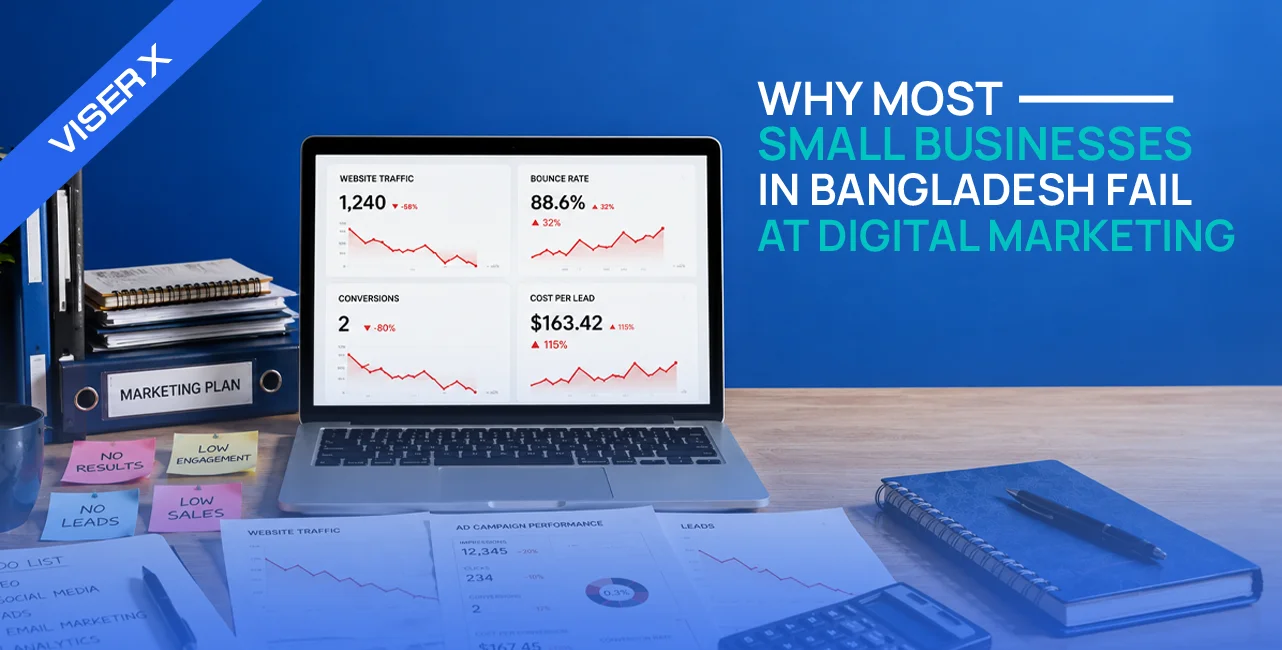


Most small businesses lose money on digital marketing because they skip the one step that actually works: a plan built around real customer behavior, not guesswork.
They boost a Facebook post, run an ad with no funnel, post content nobody reads, then wonder why a competitor with the same budget is pulling ahead.
The frustrating part is that these mistakes follow a pattern. Once you see the pattern, you can fix it, and this guide shows you exactly where Bangladeshi SMEs go wrong and what working with a top digital marketing agency in Bangladesh actually looks like when it's done right.
The Digital Marketing Landscape for Small Businesses in Bangladesh
Bangladesh's online market has grown faster than most local business owners have adjusted their strategy for it. Before fixing the mistakes, it helps to understand the scale of what's changed and why old playbooks no longer apply.
Why Digital Marketing Matters More Than Ever in Bangladesh
Bangladesh had about 77.7 million internet users in early 2025, according to DataReportal. That number has kept climbing year after year.
Most of those people are already on the platforms that matter for small business marketing. Facebook reaches roughly 67 to 73 million users in the country,
YouTube reaches about 44.6 to 49.8 million, and TikTok's ad audience covers 46.5 million adults.
Bangladesh's e-commerce market is projected to reach $13 billion by 2027, growing at 12% a year.
For a small business owner, that's not background noise. It means customers who used to walk past your shop are now scrolling past your competitor's ad instead, and every month you wait is a month of market share you don't get back.
What Sets the Bangladeshi Market Apart
Strategies copied from US or European playbooks rarely work here, and the reason comes down to how people actually search and buy.
Bangladeshi consumers search in a mix of Bangla and English, typing phrases like "cheapest basha rent Mirpur" rather than clean English queries.
Purchase decisions lean heavily on Facebook and personal trust rather than display ads or polished branding.
Festivals shape buying windows in a way most global campaign calendars ignore.
Eid, Pahela Baishakh, and Durga Puja each create concentrated spikes in spending, and a campaign that isn't timed and localized around them misses the moment entirely.
Trust is the other piece most strategies underestimate.
Many Bangladeshi shoppers stay cautious about buying online because of past run-ins with counterfeit products and payment fraud.
Businesses that invest in transparent communication, real customer reviews, and a secure, professional website earn an edge that no amount of ad spend can buy on its own.
The 7 Biggest Digital Marketing Mistakes Small Businesses in Bangladesh Make
These seven mistakes show up again and again across SMEs in Bangladesh, regardless of industry. Each one is fixable once you know what to look for.
Mistake #1: Running Ads Without a Strategy
Boosting a post because it picked up a few likes isn't a strategy.
It's a guess with a payment method attached. Thousands of small businesses in Bangladesh throw budgets at ads every month with no defined audience, no clear goal, and no way to measure whether the spend actually worked.
A real paid campaign runs on a funnel.
The top stage builds awareness among people who don't know you yet. The middle stage nurtures interest from people who are curious but not ready.
The bottom stage converts people who are ready to buy now.
Each stage needs different creative, different targeting, and a different call to action, and skipping this structure is why a large budget so often produces a small result.
What separates agencies that deliver real numbers is exactly this structure. For example, VISER X helped Strata Hygiene generate over 10x ROI on $49,710 in ad spend, not through random boosting but through a paid media funnel built around defined KPIs from day one.
That kind of return doesn't happen by accident. It's engineered, stage by stage.
Mistake #2: Ignoring SEO Entirely
Most small business owners in Bangladesh treat SEO as optional, either because they don't fully understand it or because they assume it's too slow next to paid ads.
That assumption costs them years of free traffic. SEO is the one channel that compounds: the content and authority you build today keeps pulling in visitors long after you've stopped actively working on it.
Only a few SMEs in Bangladesh have a real digital marketing strategy in place, and fewer still have any meaningful SEO work done.
That means ranking for your core search terms puts you ahead of a lot of your competitors before you've spent a single taka on ads. The bar for SEO dominance here is still low compared to more saturated markets abroad.
VISER X's work with BRAC Bangladesh shows what's possible at scale: organic traffic grew by 81%, with 216 new keywords ranking in the top 1 to 3 positions on Google.
A small business doesn't need results at that scale to feel the impact. Even a fraction of that kind of visibility can mean dozens of inbound leads a month with no ongoing ad spend.
Mistake #3: Having No Professional Website (Or a Broken One)
Sending a potential customer to a slow, outdated, or nonexistent website is the digital version of a shop with a broken sign out front.
A large share of small businesses in Bangladesh either skip a website entirely or treat their Facebook page as a full replacement for one. That's a structural mistake, not a minor oversight.
Your website is the one digital asset you actually own.
Facebook can change its algorithm overnight and reshape your reach without warning, but your website stays yours. It's also where your search traffic lands, where ad clicks turn into sales, and where a stranger decides whether your business looks credible enough to trust with their money.
Mobile performance isn't optional here either, since most internet access in Bangladesh happens on a smartphone.
A site that doesn't load cleanly within three seconds on mobile loses most visitors before they see a single product.
Mistake #4: Inconsistent or Low-Quality Content
Content powers every other channel you run, from SEO to social to paid ads.
Yet a lot of small businesses in Bangladesh treat it as an afterthought, posting irregularly, copying competitor content, or filling pages with generic filler that doesn't actually help anyone.
That habit destroys trust over time.
The Bangladeshi market rewards content that feels local and genuinely useful. A Facebook post that names a real customer pain point in everyday Bangla, or a blog post that answers exactly what your customers are typing into Google, builds trust and pulls in organic reach in a way paid ads simply can't replicate.
Consistency is what makes content compound.
A business publishing one strong blog post a week for a year ends up with 52 pieces of content driving search traffic and building authority.
A business that posts three times in January and disappears until June ends up with almost nothing to show for it. A content calendar and a clear brand voice are the difference between those two outcomes.
Mistake #5: Targeting the Wrong Audience
Facebook's ad platform is one of the most precise targeting tools ever built, and also one of the most misused by Bangladeshi SMEs.
Owners either target too broadly ("everyone in Bangladesh"), too narrowly to ever scale, or skip data entirely and go with gut feeling. Each path leads to the same place: high cost per click and low return.
Real audience research means understanding your customer's age, location, income, interests, and online habits before you spend a single taka.
For a Bangladeshi business, this also means knowing that customers in Dhaka, customers in smaller cities, and customers in rural areas don't behave the same way online.
One ad set can't speak to all three groups at once.
Mistake #6: Neglecting Analytics and Data
You can't improve what you don't measure, yet a surprising number of small businesses in Bangladesh judge a campaign by how it "feels," or worse, by vanity metrics like likes and followers, without ever checking real performance data.
That habit guarantees the same mistakes repeat month after month, because there's no visibility into what's actually working.
Google Analytics, Google Search Console, Facebook Insights, and Meta Ads Manager are all free and all give a clear view into traffic sources, audience behavior, and conversion rates.
Even understanding the basics, like which pages convert and which ad sets perform, replaces expensive guesswork with informed decisions.
The real edge comes from attribution: knowing exactly which channel, ad, and message drove each sale.
This is something VISER X tracks across every campaign, cutting underperforming ad sets and scaling what's already working so every task spent is accountable to a real outcome.
That data-first habit is what separates agencies that deliver results from ones that just deliver reports.
Mistake #7: Trying to Do Everything In-House Without Expertise
Digital marketing isn't one skill.
It spans SEO, paid advertising, content, web development, design, video, analytics, and strategy all at once.
Expecting one non-specialist employee, or the business owner themselves, to run all of it while also running the company is a setup for mediocre results across every channel.
This isn't really a budget issue. It's a cost-of-mistakes issue.
An amateur Facebook campaign that burns Tk 50,000 with nothing to show for it ends up costing more than hiring a professional who delivers a measurable return.
The idea that in-house is "cheaper" ignores the hidden cost of wasted ad spend, lost time, and growth that never happened.
The businesses seeing the strongest digital growth in Bangladesh are the ones partnering with agencies that bring real depth and a track record.
VISER X's 48-plus specialists across SEO, media buying, web development, branding, and content work as an extension of the client's own team, delivering the kind of cross-functional execution a single generalist hire can't match.
Why These Mistakes Are So Common Among Bangladeshi SMEs
These seven mistakes don't happen randomly. Three deeper patterns explain why so many small businesses fall into the same traps.
Budget Mindset: Treating Digital Marketing as an Expense, Not an Investment
The root issue for a lot of Bangladeshi small businesses is how they frame the spend itself.
Marketing gets treated as a cost to minimize rather than an investment to optimize, so it's the first thing cut when budgets tighten and the first thing abandoned when results don't show up immediately.
That short-term thinking stops any strategy from gaining the momentum it needs to compound.
SEO and content don't work like a light switch.
You can't run them for two weeks, see nothing, and conclude they don't work. The businesses that win online make a sustained commitment, track the investment carefully, and reinvest profits into what's already working.
Shifting the question from "how little can I spend" to "how much can I afford to invest for the return I want" is often the exact moment a business starts growing instead of stalling.
The research backs this up clearly.
SMEs running structured digital marketing strategies consistently outperform those without one, across traffic, leads, and revenue. The data isn't ambiguous on this point.
The real question isn't whether to invest, but how to invest with intent.
Lack of Digital Marketing Education and Awareness
Plenty of business owners in Bangladesh genuinely don't know what good digital marketing looks like.
Limited technical expertise consistently also ranks among the top three barriers to adoption for SMEs.
Without that foundation, owners can't evaluate an agency properly, can't set realistic KPIs, and can't tell a strategy that will work from one that won't.
Digital literacy is a structural gap here, not just an individual one.
Fresh graduates often arrive with theory but no practical, hands-on experience running campaigns.
Businesses without access to people who've actually done this end up either avoiding digital marketing altogether or sinking money into tactics that go nowhere, which then reinforces the false belief that "digital marketing doesn't work for us."
The fix is education paired with action, not theory alone.
Owners don't need to become marketing experts, but they do need enough literacy to ask sharp questions, hold an agency accountable, and understand which metrics actually matter.
Working with an agency that prioritizes transparency over just service delivery makes a measurable difference here.
The Copy-Paste Problem: Copying Foreign Strategies Without Localization
Bangladesh's business community has more access than ever to global marketing content: YouTube tutorials, LinkedIn posts, and courses built almost entirely for Western markets.
The problem shows up when local businesses copy these strategies word for word without adapting them for language, culture, or how people actually buy here.
A Facebook ad strategy built for a US e-commerce brand won't automatically translate to Bangladesh.
The messaging, the imagery, the offer structure, the payment methods, and even the timing all need rebuilding for the local market.
Bangladeshi consumers respond differently to creative formats, pricing language, and calls to action than audiences in other markets.
Localization is cultural intelligence, not just translation.
The campaigns that actually work in Bangladesh speak to local values, reference familiar context, and address the specific hesitations Bangladeshi buyers carry.
It's why an agency rooted in the local market, with over a decade of direct experience here, consistently outperforms one applying a template built somewhere else.
How to Build a Winning Digital Marketing Strategy as a Small Business in Bangladesh
Once you understand the mistakes, the fix is a five-step process. None of these steps are complicated on their own, but skipping any one of them weakens everything that follows.
Step 1: Define Your Goals and KPIs Before You Spend a Single Taka
Every strategy that works starts with a clear destination, not a creative idea or a platform choice.
Do you want 50 new leads a month? A 30% lift in online sales? First-page rankings for three target keywords? Without a defined goal, every taka you spend is moving without direction.
KPIs are the measurable signals that tell you whether you're actually getting closer to that goal.
For an e-commerce business, that might mean cost per acquisition, conversion rate, and average order value. For a service business, it's more likely cost per lead, lead-to-close rate, and organic traffic growth. Setting these upfront turns digital marketing into a managed function instead of a guessing game.
Vague targets don't help you. "Get more sales" tells you nothing. "Achieve a 3x ROAS on Facebook ads within 90 days on a Tk 20,000 monthly budget" gives you something specific to measure, adjust, and scale once it's working.
Step 2: Build a Mobile-Optimized, SEO-Friendly Website
Your website is the foundation everything else depends on, and it has to perform on mobile. Because most of Bangladesh's internet users access the web from a phone.
A site that loads fast, communicates your value clearly, and guides visitors toward a decision is what every other channel ultimately points back to.
SEO needs to be built in from the start, not bolted on after launch.
That means proper site structure, optimized page titles and meta descriptions, keyword-targeted content, fast load times, and clean technical architecture that search engines can actually crawl.
A site that isn't SEO-friendly is effectively invisible to Google, no matter how good it looks to a human visitor.
VISER X builds sites for performance first, not just aesthetics.
The approach folds mobile responsiveness, page speed, on-page SEO, and conversion-focused design into the build itself, which is the standard any small business serious about competing online in Bangladesh should be aiming for.
Step 3: Master Facebook and Google for the Bangladeshi Market
Facebook and Google are the two platforms that actually move the needle for Bangladeshi businesses.
Businesses that win master both rather than dabbling in each. Facebook, with 60 million users in the country, is where most purchase decisions get researched and shaped. Google is where buyers go once they're ready to act.
On Facebook, the winning formula combines precise segmentation by location, age, interest, and behavior with compelling local-language creative, A/B testing across variations, and consistent retargeting of past visitors.
Businesses that set up Facebook Pixel from the start gain a real edge, since they can build custom audiences from real behavioral data instead of assumptions.
On Google, search campaigns targeting high-commercial-intent keywords bring in buyers actively looking for what you sell, while SEO content captures the informational searches that happen earlier in the decision. Together, they create full-funnel coverage.
Step 4: Invest in Content That Educates and Converts
Content marketing is one of the highest-return activities a small business in Bangladesh can run. It is also the most underused.
Content that genuinely answers what your customers are asking builds trust, drives organic traffic, and positions your business as the obvious expert in your space.
By the time a buyer finishes reading good content, they've often already decided to buy from you.
The strongest content strategy for Bangladeshi SMEs has three parts. Short videos and carousels for Facebook and Instagram.
SEO-optimized blog content built around what people search on Google. Conversion-focused landing page copy.
Every piece should serve one clear job. Build awareness, educate a warm prospect, or close a ready buyer.
Quality beats quantity every time.
One well-researched blog post that ranks on Google's first page will generate more leads over its lifetime than a hundred generic posts nobody reads.
Spend the time understanding what your customers are actually asking, write the most thorough answer available, and watch the traffic and trust build steadily from there.
Step 5: Track, Measure, and Optimize Continuously
Digital marketing isn't something you set up once and walk away from.
It's a constant cycle of testing, measuring, and refining. The businesses that consistently outperform competitors usually don't have bigger budgets.
They have better data habits, knowing exactly which ads work, which content converts, and where their best customers come from.
Set up Google Analytics 4 and Google Search Console on your site from day one.
Add Facebook Pixel and conversion tracking to every ad campaign you run. Define your conversion events, whether that's form submissions, calls, purchases, or WhatsApp clicks, and track them religiously.
Review performance weekly rather than monthly, so underperforming campaigns get caught and fixed early instead of draining budget for a month.
The goal is a feedback loop: launch, measure, identify what worked and what didn't, scale the winners, cut the losers, repeat.
Over time, this systematic approach lowers cost per acquisition, raises ROAS, and compounds growth.
What Happens When Small Businesses Get Digital Marketing Right
The pattern across Bangladesh's most successful digital marketing campaigns is consistent: when a business stops guessing and starts executing with a real strategy, the results compound fast.
HATIL Furniture, one of Bangladesh's most recognized furniture brands, achieved 116.7% organic growth and a 305.7% revenue increase through VISER X's SEO and digital strategy.
proof that search-led growth drives real revenue even for established names.
For a small business, the takeaway is encouraging: you don't need a corporate budget to get real digital marketing results in Bangladesh.
What you need is a clear strategy, the right expertise behind it, consistent execution, and the discipline to measure and adjust. These case studies share the same DNA. Not luck, not a massive ad spend, but structured, data-driven marketing that respects how Bangladeshi consumers actually buy.
Stop Repeating the Same Mistakes, Start Growing Your Business Online
The difference between Bangladeshi small businesses that grow online and the ones that stall isn't luck, budget, or industry. It's a strategy.
Every mistake in this guide is avoidable, and every result shared here is repeatable with the right approach behind it.
VISER X has spent over 10 years helping businesses grow across Bangladesh and 20-plus countries, with 48-plus specialists covering SEO, media buying, web development, content, branding, and design.
The work isn't generic. It's built around data and engineered for measurable results, from early-stage startups to enterprise names like BRAC, BAT Bangladesh, and HATIL.
If your business is still making the mistakes in this guide, the fix starts with one decision: stop guessing and start measuring.
The market is growing fast, the opportunity is real, and the only open question is whether you act on it before your competitors do.
Your Digital Marketing Questions, Answered
What does digital marketing actually cost a small business in Bangladesh?
It depends on the channel mix, but a structured Tk 20,000–50,000 monthly budget with clear KPIs outperforms a larger budget spent without a plan.
Which digital marketing channel works best for small businesses in Bangladesh?
Facebook builds awareness and trust where 60 million Bangladeshis already are, while Google captures buyers who are ready to act, so the strongest results come from running both together.
How long does it take to see results from digital marketing in Bangladesh?
Paid ads can show signals within weeks, but SEO and content marketing compound over months and keep paying off long after the work is done.
Do I need a website if I have a Facebook business page?
Yes, because a Facebook page is rented space controlled by the platform, while your website is the one digital asset you actually own.
Should I hire a digital marketing agency or do it myself?
Hire an agency once you weigh the time it takes to master SEO, ads, content, and analytics against the cost of wasted spend from learning on the job.
What is the best digital marketing agency for small businesses in Bangladesh?
Look for one with documented, verifiable results in the local market, like VISER X's 80.83% organic traffic growth for BRAC Bangladesh, rather than vague claims of being "the best