In-House PPC vs. Agency PPC: Which Drives Better ROI?
- Post By: FAISAL MUSTAFA
- Published: July 26, 2026
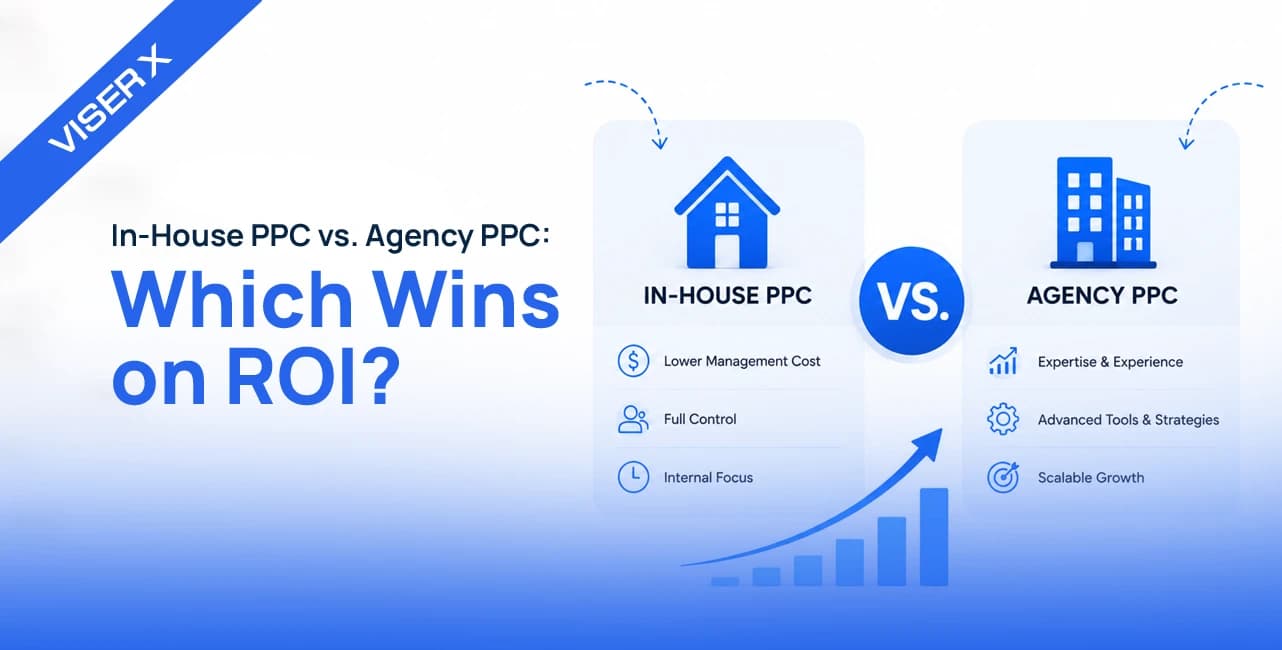


If you manage $5,000 to $15,000 a month in ad spend, hiring a specialized PPC management agency usually wins on ROI, because you get a full team of specialists for less than one in-house salary. If you spend $50,000 or more per month and need tight control over strategy, the in-house vs. agency PPC decision often tips toward building an internal team.
The right answer depends on your budget, your growth stage, and how much control you need over daily decisions.
Let's dive into the discussion to know about the real costs, the hidden trade-offs, and a simple framework to help you choose with confidence.
Quick Answer: Agency or In-House - Which Wins?
There's no single winner. The decision comes down to your ad spend level and the level of internal support you can offer.
|
|
|
|
|
|
|
|
|
|
|
|
|
|
|
|
|
|
|
|
|
Agencies win on cost efficiency and specialist depth for small to mid-size budgets. In-house wins on control and product knowledge once you spend justifies a full-time hire. Most growing businesses land somewhere in between, which is why the hybrid model at the end of this guide is worth a real look.
What Is In-House PPC?
In-house PPC means hiring someone on your payroll to manage your Google Ads, Meta Ads, or other paid campaigns from inside your company. This person sits with your team, knows your product, and reports directly to you.
The appeal is obvious. You get someone who lives and breathes your business every day. They understand your customers without a briefing call, and they can react the moment a product changes or a promotion needs to go live.
What an in-house PPC hire actually needs to do
A single in-house hire is rarely just running ads. In practice, they're expected to cover:
- Campaign setup and daily bid management
- Keyword research and negative keyword maintenance
- Ad copywriting and creative briefs for design
- Landing page recommendations and conversion tracking setup
- Competitor monitoring
- Monthly reporting to leadership
- Staying current on platform updates (Google and Meta change their algorithms constantly)
That's a lot of ground for one person. In most companies, only about half of an in-house PPC manager's time is actually spent on campaign optimization.
The rest gets absorbed by internal meetings, reporting, and cross-team coordination, which quietly eats into the ROI you're paying a full salary for.
What Is an Agency PPC?
Agency PPC means outsourcing your paid campaigns to a specialized team that manages ad accounts for multiple clients at once. You're not hiring one person. You're renting a team of strategists, copywriters, and analysts who already know the platforms inside out.
What a PPC agency actually delivers day to day
A capable agency isn't just pushing buttons in an ad dashboard. The real value shows up in:
- Cross-account pattern recognition (they've seen what works across dozens of similar businesses)
- Faster adaptation when Google or Meta rolls out algorithm changes
- Built-in coverage, so campaigns don't stall when one person is on leave
- Access to enterprise-level tools that most single hires can't justify buying
- Specialist roles (a strategist, a copywriter, an analyst) instead of one generalist wearing every hat
The trade-off is less day-to-day face time and, at times, a learning curve while the agency gets to know your product and audience.
The Real Cost Comparison: What You're Actually Paying For
Most business owners compare a monthly retainer to a single salary line and think they've done the math. They haven't. The full picture includes costs that rarely show up in that first back-of-napkin comparison.
The hidden cost of an in-house hire
A mid-level PPC manager typically earns $70,000 to $90,000 a year in base salary. However, that line item is only part of the equation.
When you add 20–30% for benefits, recruitment fees, ongoing training, and PPC software like SEMrush or Optmyzr ($500 to $2,000 per month), the true cost rises sharply. Ultimately, an in-house hire will cost you between $8,000 and $12,000 per month, whether your ad budget is $5,000 or $50,000.
That math matters. If you're spending $5,000 a month on ads, you could end up spending more on management than on the media itself.
What agency PPC actually costs
Agencies typically use one of three pricing models: a flat monthly retainer, a percentage of ad spend (usually 10-20%), or a hybrid of both. For most small to mid-size businesses, that works out to roughly:
|
|
|
|
|
|
|
|
|
|
|
|
At lower spend levels, agency PPC management costs usually beat an in-house hire by a wide margin, because you're splitting one team's cost across many clients instead of carrying it alone.
Expertise and Speed: Where Each Model Wins
Neither model is automatically better. Each one wins on different fronts, and knowing which fronts matter to your business is the real decision point.
Where agencies pull ahead
Agencies see patterns that a single in-house hire never will. When they manage accounts across dozens of businesses in different industries, they spot what's working (and what's quietly failing) faster than someone managing just one account.
That translates into:
- Faster reaction to platform changes, since they're testing updates across many accounts at once
- Broader platform coverage (Google, Meta, LinkedIn, Microsoft Ads) without you hiring a specialist for each
- No single point of failure. If one team member is out, the account doesn't stall
Where in-house pulls ahead
In-house wins on context and speed of internal decisions. When your PPC manager sits three desks away from your product team, changes happen faster. There's no briefing call, no waiting for an agency's next check-in. In-house also tends to win when:
- Your product or service needs deep technical knowledge to write accurate ad copy
- You need same-day changes tied to inventory, promotions, or pricing
- Data ownership and privacy are a priority (everything stays inside your systems)
PPC ROI: What Actually Drives Results (Regardless of Model)
Here's the part most comparisons skip: the model you choose matters less than the fundamentals getting executed well. Whether it's an in-house hire or an agency, PPC ROI depends on the same core levers.
Quality Score is one of the biggest. Advertisers with Quality Scores of 8-10 see roughly 50% lower cost-per-click and 50% higher ad positions than advertisers scoring 4-6 on the same keywords. That gap compounds every month, which means whoever manages your account needs to actively work on ad relevance and landing page experience, not just bid amounts.
Account structure matters just as much. Tightly themed ad groups with clear keyword-to-ad-to-landing-page alignment consistently outperform broad, loosely organized campaigns. A well-organized account also directly affects your click-through and conversion rates, the two metrics that determine whether your ad spend turns into revenue.
Conversion tracking accuracy is the piece most businesses underinvest in. If your tracking is broken or incomplete, neither an in-house hire nor an agency can optimize toward real results, because they're optimizing against bad data.
In practice, the common mistake we see is businesses switching from in-house to agency (or the reverse), expecting a fix, when the actual problem was a weak account structure or missing conversion tracking all along. Fix the fundamentals first. The management model is a distant second factor.
The Hybrid Model: A Middle Ground Worth Considering
A growing number of mid-size businesses are adopting a hybrid PPC management model rather than picking a single side.
This usually looks like one in-house marketer who owns strategy, brand voice, and internal coordination, paired with an agency that handles execution, testing, and platform-specific optimization.
This setup gives you the product context and speed of an internal hire, plus the specialist depth and coverage of an agency, without paying for a full internal team you don't need yet. It's especially common once a business crosses into multi-platform advertising, where no single hire can realistically stay expert in running Google Ads management, Meta campaigns, and LinkedIn Ads at once.
A Simple Decision Framework: Which Model Fits Your Business?
Use this as a starting checklist rather than a rigid rule. Most businesses will see themselves clearly in one column.
Choose agency PPC if
- Your monthly ad spend is under $15,000-$20,000
- You need multi-platform expertise without multiple hires
- You don't have the internal bandwidth to manage a vendor relationship closely
- You want built-in coverage and no key-person risk
Build in-house PPC if
- Your ad spend consistently exceeds $50,000/month
- Your product requires deep technical or industry knowledge to advertise accurately
- You need same-day changes tied to inventory or pricing
- Data ownership inside your own systems is a hard requirement
Go hybrid if
- You're scaling past a single platform and need both strategy ownership and execution depth
- You want internal brand control, but don't want to build a full paid media team yet
- You're testing whether full in-house makes sense before committing to headcount
In-House PPC vs. Agency PPC in Bangladesh: What's Different
The in-house vs. agency Google Ads decision looks different in Bangladesh than it does in the US or the UK, mainly because of the cost structure and talent availability.
A mid-level PPC specialist in Dhaka typically costs a fraction of a US salary, which makes in-house feel more affordable on paper. But experienced PPC talent, especially with multi-platform and international campaign experience, is harder to find and retain locally.
Agencies operating in Bangladesh, including firms serving international clients, often charge 10-20% of ad spend or flat packages ranging from roughly BDT 15,000 to BDT 200,000+ per month, depending on scope.
For businesses running campaigns aimed at global markets from Bangladesh, an experienced local agency frequently delivers better ROI than a first-time in-house hire, simply because agencies bring exposure to international account benchmarks that a single local hire may not have encountered yet.
For businesses weighing the best PPC agency for small-business ROI in this market, the agency route generally offers more consistent results in the first 12 months, with the option to build an internal team later, once spend and complexity justify it.
How to Choose the Right PPC Agency
Not all agencies deliver the same value, even at similar price points. Before signing a contract, check for:
- Clear reporting on the metrics that matter: CPA, ROAS, and conversion rate, not just clicks and impressions
- Transparent pricing: You should know exactly what the fee covers, whether it's a flat retainer or a percentage of spend
- Relevant experience: Case studies in your industry or a comparable business size, not just generic client logos
- Direct communication: A dedicated point of contact, not a rotating cast of account managers
- No lock-in pressure: Month-to-month or short-term contracts signal confidence in their own results
If an agency stays vague about what's included in the fee or avoids specific performance numbers, treat that as a warning sign before you sign anything.
Why Businesses Choose VISER X for Agency PPC
VISER X has spent over a decade running paid media campaigns for businesses in more than 20 countries, which means our team has seen how PPC performs across industries that most single in-house hires are never exposed to.
We build account structures around Quality Score and conversion tracking from day one, not as an afterthought, because that's what actually moves ROI regardless of platform.
Whether you need full agency management or a hybrid setup that works alongside your internal team, our Google Ads management service is built to plug into your business without the overhead of a full internal hire. If you're still weighing paid versus organic growth, our breakdown of SEO versus PPC is a useful next read before you commit budget either way.
Frequently Asked Questions
Is it cheaper to manage PPC in-house or hire an agency?
For most businesses spending under $15,000-$20,000 a month, an agency is cheaper once you account for salary, benefits, tools, and training that come with an in-house hire. Above that spend level, the math starts to shift depending on your specific setup.
How much do PPC agencies charge?
Most agencies charge either a flat monthly retainer or 10-20% of your ad spend. Smaller accounts typically pay $1,500-$3,000/month, while larger accounts can run $8,000-$25,000+/month depending on scope and platforms managed.
Can I use an in-house team and a PPC agency together?
Yes. This hybrid PPC management model is common among growing businesses. An in-house person owns strategy and brand context, while the agency handles execution, testing, and platform-specific optimization.
What ad spend level justifies hiring in-house?
Most businesses see in-house PPC start to make financial sense once monthly ad spend consistently exceeds $50,000, since that's roughly when management costs become a smaller share of total spend.
How do I know if my PPC agency is doing a good job?
Look past clicks and impressions. A good agency reports clearly on CPA, ROAS, and conversion rate, explains changes before making them, and can show you Quality Score trends over time, not just a single month's snapshot