Everything You Need to Know About Advertising on AI Search Engines
- Post By: FAISAL MUSTAFA
- Published: April 18, 2026
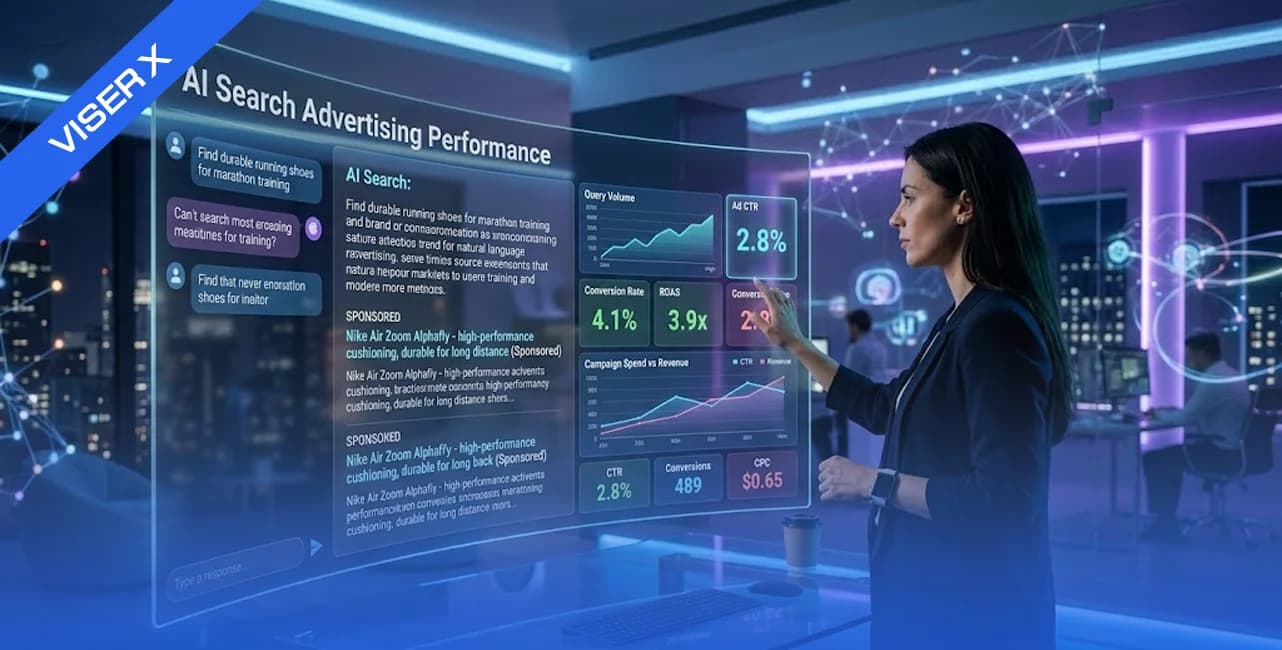


Advertising on AI search engines is one of the fastest-moving topics in digital marketing right now.
Today’s discussion explains what AI search engines are, how advertising on them works, which platforms currently offer paid options, what they cost, how to get started, and what the future looks like.
By the end, you will have a clear and practical picture of where to invest, what to avoid, and how VISER X helps businesses navigate this new advertising landscape
Advertising on AI Search Engines
Advertising on AI search engines is no longer a future trend. It is happening right now across platforms like ChatGPT, Google AI Overview, and Microsoft Copilot, and the rules are completely different from traditional search advertising.
Advertising on AI search engines is one of the most important shifts in digital marketing in more than a decade.
Billions of people are now turning to AI-powered tools like ChatGPT, Google AI Mode, and Perplexity to find answers, compare products, and make buying decisions. The way brands reach those people is changing fast.
Traditional search advertising relied on keywords and ranked links. AI search advertising is conversational, intent-driven, and built around answers rather than clicks.
Businesses that understand this difference early will capture enormous visibility while their competitors are still figuring out what is happening.
Thus, VISER X breaks down everything you need to know about this new advertising frontier in plain and simple language.
What Are AI Search Engines?
AI search engines use artificial intelligence to understand your question and give you a direct, conversational answer rather than just showing a list of links. They read and synthesize information from across the web and respond like a knowledgeable assistant.
Traditional search engines like Google show you a list of links. You click through and find your answer yourself. AI search engines skip that step.
They read millions of sources, synthesize the best information, and deliver a direct answer in a few sentences.
Examples of AI search engines in 2026:
- ChatGPT Search by OpenAI with over 900 million weekly active users
- Google AI Overview and AI Mode reaching over 2 billion monthly users across 200 countries
- Microsoft Copilot is integrated into Bing and Microsoft 365 products
- Perplexity AI, with over 780 million monthly queries and a subscription model
- Claude by Anthropic is committed to remaining completely ad-free
How Is Advertising on AI Search Engines Different from Traditional Search Ads?
Traditional search ads appear beside keyword-matched links. AI search ads appear inside or alongside conversational answers. The intent is deeper, the context is richer, and the user is much further along in their decision-making process.
Traditional Search Advertising
Traditional search advertising works on a keyword bidding model. You pick keywords, set a budget, and your ad appears when someone searches that term. The user sees a list of results, your ad at the top or bottom, and decides whether to click.
AI Search Advertising
AI search advertising works differently because the search itself is different. A user asks a full question in natural language.
The AI synthesizes an answer. Ads appear alongside or within that answer in clearly labeled positions. The user is already in a decision-making mindset because they asked a specific, detailed question. This makes the intent far more valuable.
|
Dimension |
Traditional Search Ads |
AI Search Ads |
|
Format |
Keyword-matched text links |
Sponsored placements beside AI answers |
|
User intent |
Browsing or early research |
Specific question, ready to act |
|
Targeting |
Keywords and demographics |
Conversation topics and query context |
|
Bidding |
Cost per click auctions |
CPM based impression buying |
|
Control |
High, you choose exact keywords |
Lower, AI determines context match |
|
Trust signal |
Ad label, the user knows it is paid |
Trust depends heavily on placement quality |
What AI Search Platforms Currently Offer Advertising?
In 2026, each major AI search platform has taken a different approach to advertising. Some are fully open, some are testing, and some have rejected ads entirely. Understanding which is which is the first step to building your strategy.
Google AI Overview Advertising
Google AI Overview is the most accessible AI search advertising opportunity in 2026. According to Digital Applied, Ads now appear in 25.5 percent of all AI Overview responses, up from just 5 percent in early 2025.
Google has also launched a dedicated shopping ad format inside AI Mode, which reaches over 75 million daily active users.
Because Google uses its existing Google Ads infrastructure, advertisers can use their current campaigns to gain visibility in AI results.
ChatGPT and OpenAI
OpenAI launched ads in ChatGPT in February 2026 for users on its Free and Go tiers. Ads appear as clearly labeled sponsored results below organic answers and never influence the AI responses themselves.
According to MEXC, the platform reached $100 million in annualized ad revenue within two months of launch, making it the fastest-growing new ad platform since TikTok.
Paid subscribers on Plus, Pro, Business, and Enterprise plans see no ads at all.
Perplexity Advertising Program
Perplexity began testing ads in late 2024 but permanently shut down its advertising program on February 18, 2026.
The company cited concerns about user trust, stating that ads risk making users doubt the accuracy of every answer.
Perplexity is now fully subscription-based and cannot be accessed through paid placements. Brands can only appear in Perplexity through organic citation, which requires high-quality content and strong authority signals.
Microsoft Copilot and Bing Chat
Microsoft has tested ads inside Copilot and continues to integrate advertising into its AI-powered search experience through its Microsoft Advertising platform.
Businesses already running Microsoft Ads can extend campaigns into Copilot placements. It is particularly relevant for B2B advertisers and those targeting enterprise decision-makers who use Microsoft 365 products daily.
Other Emerging Platforms
- Claude by Anthropic has publicly committed to being permanently ad-free and ran Super Bowl ads making that point directly
- Meta AI is building AI advertising capabilities across Facebook, Instagram, and WhatsApp, with no confirmed launch date yet
- Baidu operates the dominant AI search advertising market in China through its ERNIE model and Baidu Tuiguang ad platform
How Much Does Advertising on AI Search Engines Cost?
AI search advertising costs vary significantly by platform, format, and audience. ChatGPT currently charges around $60 CPM. Google AI Overview ads follow the same pricing as Google Ads. There is no single standard rate across the industry yet.
|
Platform |
Ad Model |
Estimated Cost |
Availability |
|
Google AI Overview |
Existing Google Ads infrastructure |
Your current CPC or CPM rates |
Open to all advertisers |
|
ChatGPT (OpenAI) |
CPM impression-based |
Approx $60 CPM |
Pilot expanding |
|
Microsoft Copilot |
Microsoft Advertising extension |
Varies with campaign type |
Open to Microsoft Ads users |
|
Perplexity |
No advertising |
Not applicable |
Closed to all advertisers |
|
Claude (Anthropic) |
No advertising |
Not applicable |
No plans for ads |
According to eMarketer forecasts, AI search ad spend in the US is projected to grow from $1 billion in 2025 to $25.9 billion by 2029. That is a 13.6 percent share of all search ad spending. Early movers who build platform expertise now will capture returns that late adopters will pay heavily to access
How Do I Get Started with AI Search Engine Advertising?
Getting started with AI search advertising requires auditing your current presence, choosing the right platforms for your audience, optimizing your content for AI discovery, and setting up campaigns through the platforms that currently accept advertising.
Step 1: Audit Your Current Digital Presence
Before spending a dollar on AI search advertising, type your brand name and core services into ChatGPT, Perplexity, Google AI Mode, and Microsoft Copilot. See how each platform describes your business. If responses are inaccurate, incomplete, or missing entirely, that gap is what you need to close first.
- Check organic AI citations across all major platforms
- Review your structured data, including schema types such as FAQ schema, product schema, and how-to markup
- Assess your content depth and whether it answers the questions your buyers actually ask
Step 2: Choose Your Platforms
Not every AI platform accepts advertising. Match your platform choice to where your audience lives:
- Google AI Overview, if you already run Google Ads and want maximum reach
- ChatGPT, if your audience is tech-forward and you want to reach free-tier users at scale
- Microsoft Copilot, if you target enterprise professionals or B2B buyers
- Perplexity and Claude, through organic citation only, no paid options available
Step 3: Optimize for AI Discoverability
On platforms where you cannot buy placement, you must earn it. Generative Engine Optimization, or GEO, is the practice of structuring your content so AI systems choose to cite you.
Key actions:
- Add FAQ and structured data schema to all key pages
- Write content that directly answers specific questions your buyers type into AI
- Build external authority through backlinks, brand mentions, and industry citations
- Create original data that AI cannot find anywhere else online
Step 4: Set Up Your Campaigns
For Google AI Overview: use your existing Google Ads account and enable Performance Max campaigns. These automatically extend into AI Overview placements.
- For ChatGPT: apply through OpenAI's advertising partner program.
- For Microsoft Copilot: extend existing Microsoft Advertising campaigns through the Copilot ad integration.
Step 5: Monitor and Optimize
- Track AI citations using tools like Otterly.ai, Goodie AI, or Semrush AI Visibility Overview
- Monitor brand mentions across all major AI platforms weekly
- Test ad creative formats and messaging relevance within AI contexts
- Measure conversion impact, not just clicks or impressions
What Are the Best Practices for AI Search Engine Advertising?
The most important best practice for AI search advertising is relevance. Ads that feel like helpful answers rather than interruptions perform significantly better. Brands that invest in being genuinely useful in AI conversations win the most trust.
|
Best Practice |
Why It Matters |
|
Prioritize relevance over reach |
63 percent of users say AI ads reduce trust if they feel irrelevant |
|
Use conversational ad copy |
AI search is dialogue-based, so your messaging should match that tone |
|
Earn organic citations in parallel |
Organic AI mentions carry more trust than labeled ads on every platform |
|
Build EEAT signals aggressively |
Expertise, Experience, Authoritativeness, and Trust drive AI citation selection |
|
Avoid keyword-heavy copy |
AI context matching differs from keyword targeting, so write naturally |
|
Test early at lower budgets |
The landscape is evolving fast, and small early tests beat large late commitments |
|
Align ads with the full funnel |
AI search users are often close to a decision so point them to conversion pages |
How Do I Measure Success in AI Search Advertising?
Measuring success in AI search advertising requires different metrics than traditional search. Because attribution is harder and the user journey is more complex, brands need to track AI citation frequency, brand search lift, and conversion quality alongside standard ad metrics.
|
Metric |
What It Tells You |
How to Track It |
|
AI citation frequency |
How often do AI tools reference your brand organically |
Otterly.ai, Goodie AI, Semrush |
|
Brand search lift |
Whether AI exposure increases branded searches on Google |
Google Search Console |
|
Impression share in AI Mode |
How visible your ads are within AI-generated results |
Google Ads AI Overview reports |
|
Conversion quality |
Whether AI-referred visitors convert at higher or lower rates |
GA4 segment comparisons |
|
Cost per AI-assisted conversion |
Total AI ad spend divided by conversions from those visitors |
Attribution modeling |
What Are the Common Challenges with AI Search Advertising?
AI search advertising is exciting, but it comes with real challenges, including limited advertiser control, difficult attribution, a constantly shifting platform landscape, and significant cost uncertainty. Knowing these going in prevents painful surprises.
Limited Control Over Messaging
In AI search advertising, your ad appears alongside a generated answer, but you cannot control what that answer says.
If the AI response and your ad send conflicting signals, the mismatch reduces trust. Brand consistency and alignment between your organic content and your ad messaging are essential.
Attribution Difficulties
Traditional search ads have clear click-to-conversion paths. AI search advertising introduces a longer and less direct journey.
A user might see your ad in ChatGPT, research more on Google, and convert a week later through a direct visit.
Multi-touch attribution modeling is essential, and most businesses are not set up for it yet.
Evolving Landscape
The AI search advertising market is changing every month. Perplexity abandoned ads in February 2026 after testing them for two years.
ChatGPT launched ads the same month and hit $100 million in revenue in weeks. What works today may not work in six months.
Businesses need flexible strategy partners, not rigid campaign structures.
Cost Uncertainty
There is no established cost benchmark for AI search engine advertising yet. ChatGPT's $60 CPM is high compared to traditional search.
Google AI Mode placements use your existing Google Ads rates but compete in a new auction environment.
Budgets should be treated as test investments with clear performance gates rather than long-term commitments.
How Is AI Search Advertising Different for B2B vs. B2C?
B2B and B2C brands have very different opportunities in AI search advertising. B2B advertisers benefit most from organic citation building and Microsoft Copilot placements. B2C advertisers should prioritize Google AI Mode shopping formats and ChatGPT brand visibility.
|
Factor |
B2B Strategy |
B2C Strategy |
|
Best platform |
Microsoft Copilot and Google AI Mode |
ChatGPT and Google AI Overview |
|
Primary goal |
Build brand authority and earn citations |
Drive direct product discovery and purchases |
|
Content focus |
Thought leadership, case studies, whitepapers |
Product pages, reviews, comparison content |
|
Ad format |
Text and sponsored content placements |
Shopping ads and visual product formats |
|
Budget approach |
Test and learn with a modest dedicated budget |
Extend existing Google Ads campaigns first |
What Does the Future Hold for AI Search Engine Advertising?
The future of AI search advertising is a large and fast-growing market. US advertisers are projected to spend $25.9 billion on AI search ads by 2029. Brands that build their expertise and content authority now will have a significant and compounding advantage over latecomers.
Several trends are shaping the near future of this space:
- More platforms will open to ads as the revenue imperative grows. Meta AI, Gemini, and others will likely introduce advertising in 2026 or 2027
- AI watermarking and transparency requirements will make ad labeling more standardized across all platforms
- Organic AI citations will become more valuable as users develop ad blindness in AI search results, just as they did in traditional search
- Performance measurement tools will improve, making attribution clearer and ROI easier to calculate
- AI-native ad formats will emerge that are specifically designed for conversational search rather than adapted from traditional search formats
The brands that invest in understanding this landscape today will not just save money. They will build a compounding advantage in AI search visibility that latecomers will struggle to close.
Getting Help with Your AI Search Advertising Strategy
VISER X helps businesses build AI search advertising strategies that combine paid placements where available with organic citation building where they are not. Our media buying team manages the full landscape, so you do not have to navigate it alone.
At VISER X, we work with businesses at every stage of AI search readiness. Whether you are just discovering that your brand is invisible in ChatGPT results or you are ready to scale your Google AI Mode advertising budget, our team maps the right path for your specific goals and industry.
Our approach to AI search advertising covers four areas that most agencies are still ignoring:
- Platform audit and citation analysis to understand where you stand organically across all major AI tools
- Paid campaign setup and management through Google Ads AI Mode and ChatGPT advertising pilot programs
- Generative Engine Optimization to build the content authority that earns organic citations on platforms where paid options do not exist
- Attribution setup and reporting so you can see the actual business impact of your AI search investment
You can learn more about our media buying and AI search advertising services to get a clearer picture. If you are ready to discuss your strategy, book a free session, and we will show you exactly where the opportunities are in your market
Ready to Build Your AI Search Advertising Strategy?
VISER X maps your current AI visibility, sets up your campaigns, and builds the content authority that earns organic citations. Book a free strategy session today.
Frequently Asked Questions
Can small businesses afford AI search advertising?
Yes. Start with Google Ads. Your existing campaigns already qualify for AI Overview placements at no extra cost.
Do I need to stop traditional SEO if I focus on AI search?
No. Traditional SEO and AI search optimization work together. Strong SEO directly improves your AI citation visibility.
How long does it take to see results from AI search advertising?
Paid placements show results immediately. Organic AI citation building typically takes three to six months.
What industries benefit most from AI search advertising?
Technology, finance, healthcare, legal, real estate, and education benefit most due to high research-driven buyer intent.
Is AI search advertising worth it in 2026?
Yes. AI search ad spend is projected to grow to $25.9 billion by 2029. Early movers win the biggest advantage.