How to Optimize Your Website for AI Visibility (Complete Guide for 2026)
- Post By: FAISAL MUSTAFA
- Published: May 12, 2026
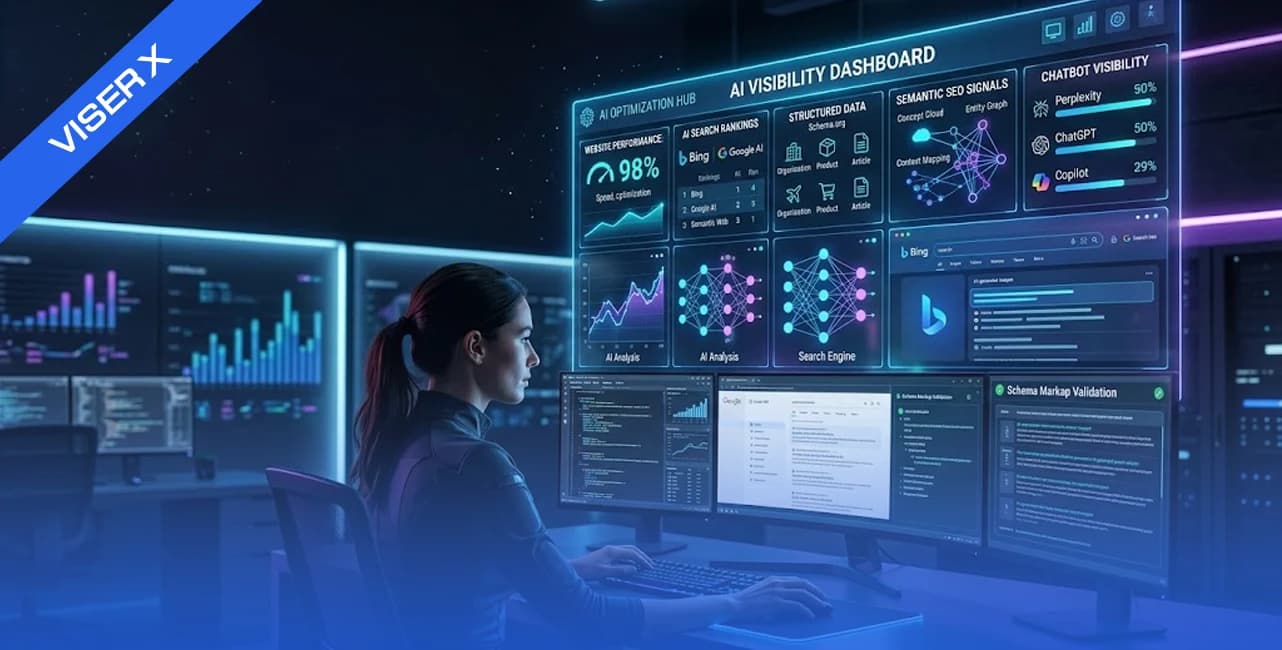


Optimizing your website for AI visibility comes down to one shift in thinking: stop chasing rankings and start earning citations.
As ChatGPT, Perplexity, and Google AI Overviews handle more searches every day, the question is no longer "do I rank?", it's "does AI cite me?"
This guide gives you a complete, research-backed framework to build that presence in 2026.
What Is AI Visibility and Why Does It Matter More Than Rankings Now?
AI visibility is your brand's presence in AI-generated answers.
It determines whether ChatGPT names you when someone asks for the best solution in your space, or whether Google's AI Overview cites your content in its synthesized response.
It is not about ranking. It is about being extracted, cited, and framed accurately by the AI tools that now answer your customers' questions before they ever reach your website.
Also called answer engine optimization (AEO), generative engine optimization (GEO), or LLM SEO, AI visibility is the practice of optimizing your digital presence so AI-powered platforms reliably surface and describe your brand in generated answers.
Unlike traditional SEO, which targets search engine result pages, it targets the language models behind ChatGPT, Perplexity, Google AI Overviews, Gemini, and Microsoft Copilot.
Success is measured not in rankings but in citation frequency, share of voice, and AI-generated brand sentiment.
This matters now more than ever. According to data published by Forbes in March 2026, over 60% of Google searches end without a single click.
Millions of users ask AI tools their questions and accept the generated answer, never visiting a website. That number will only grow as AI-generated answers get richer and more conversational.

Image: Example of a Google AI Overview result for the query "how to optimize website for AI visibility
Traditional SEO vs. AI SEO vs. AEO vs. GEO
Not all search optimization is the same anymore.
Traditional SEO gets you ranked. AI SEO makes sure AI can read your site. AEO gets you cited in AI answers. GEO ensures your brand appears accurately in AI-generated summaries.
The table below breaks down exactly how they differ.
|
Aspect |
Traditional SEO |
AI SEO |
AEO |
GEO |
|
Goal |
Rank in SERPs |
Ensure AI can crawl and process your site |
Be directly cited in AI answers |
Appear positively in generated summaries |
|
Success Metric |
Traffic, click-through rate |
Citation rate, passage extraction |
Snippet selection frequency |
Brand attribution accuracy |
|
Core Signals |
Backlinks, keywords |
Schema, entity consistency |
Passage structure, readability |
Authority, third-party mentions |
|
User Journey |
Click → visit → convert |
Zero-click brand impression |
Instant answer satisfaction |
Multi-source synthesized trust |
Why Zero-Click AI Answers Are Changing Everything
When a user asks ChatGPT, "What's the best digital marketing agency in Dhaka?" and receives a confident, synthesized paragraph, they form a brand opinion with zero clicks.
Traditional conversion funnels assume website visits. The AI era eliminates that assumption entirely. Brands that don't invest in AI visibility are handing that first impression to competitors who do.
Key Takeaway: In a zero-click world, citations are the new currency of digital visibility. You don't need the click, you need the mention. Every AI citation is a brand impression at the moment of highest user intent.
The Four AI Surfaces That Determine Your Brand Visibility
Your brand can appear or disappear, across four major AI surfaces:
- Google AI Overviews: Synthesized answers at the top of Google SERPs, drawing from freshly indexed, structured content
- Chat Assistants (ChatGPT, Claude, Perplexity): Conversational AI tools with real-time retrieval that favor third-party authority and community-validated content
- Knowledge Panels: Entity-based boxes drawing from Google's Knowledge Graph and Wikidata, appearing in both SERPs and AI Overviews
- Marketplace AIs (Amazon Rufus, etc.): Product-focused AI that pulls from structured schema, merchant feeds, and verified product data
How AI Search Systems Retrieve and Cite Your Content
Before optimizing, you need to understand the mechanism.
Each AI platform retrieves content differently, and what works for Google's AI Mode may underperform on Perplexity.
Here's how each platform works under the hood.
The Retrieval Logic Behind Google AI Overviews
Google AI Overviews scans Google's existing index, identifies passages most relevant to a query using passage-level extraction, paraphrases them into a synthesized answer, and cites source URLs.
Google AI Mode uses a technique called query fan-out: it breaks your query into multiple parallel sub-queries, retrieves results for each, and synthesizes a comprehensive answer.
The retrieval logic matters as much as the content itself. see how to rank in Google's AI Mode for a full breakdown.
Why AI Pulls From Subtopics and How to Get Cited More Often
When Google AI receives a single query, it breaks it into multiple sub-queries and retrieves content for each one independently.
This is called query fan-out. A comprehensive article that covers all angles of a topic gets cited across multiple sub-queries, not just one.
Sites that cover topics shallowly get cited once, if at all. Sites that go deep, with dedicated passages on definitions, comparisons, implementation, and FAQs, appear across the full fan-out of any related query.
To leverage fan-out:
- Map subtopics for each target query using tools like Ahrefs or Semrush
- Create a dedicated H2 or H3 for each subtopic within one comprehensive article
- Self-contained each passage with a clear answer and supporting context
How ChatGPT Search Retrieves Content
ChatGPT uses live web retrieval via Bing, pulling pages that rank well in Bing's index.
It shows a strong preference for third-party roundups, editorial publications like Forbes and Investopedia, and high-activity Reddit threads, over brand-owned content.
A Fullintel–University of Connecticut study, presented at the International Public Relations Research Conference in 2026, found that 47% of all AI citations came from journalistic sources and only 5% from brand-owned content.
Brands that only publish on their own domain stay largely invisible to AI tools, no matter how good their content is.
Earned media coverage, press mentions, third-party features, industry citations, is what gets you into AI-generated answers.
How Perplexity Retrieves Content
Perplexity weights recency, UGC signals, and community validation.
Reddit is the single most cited domain across all major AI platforms, aggregated across ChatGPT, Google AI Overviews, and Perplexity.
Perplexity specifically weights community discussions on Reddit and Quora as trust signals because they provide real-world context that complements factual sources.
Platform-by-Platform Citation Signal Map
|
Platform |
Top Signal 1 |
Top Signal 2 |
Content Type Preferred |
Unique Factor |
|
Google AI Mode |
Google search ranking |
Passage structure & freshness |
Direct-answer sections |
Query fan-out rewards subtopic depth |
|
ChatGPT |
Referring domains / Bing authority |
Third-party editorial mentions |
Roundups, "Best X for 2026" lists |
Journalistic sources cited 47% of the time |
|
Perplexity |
UGC signals (Reddit/Quora) |
Community validation |
Forum discussions, review threads |
Reddit is the #1 most-cited domain overall |
|
Gemini |
Google properties & Business Profile |
Structured data/Schema |
Schema-rich product/service pages |
Entity integration via Google Knowledge Graph |
The 5 Core Areas You Must Optimize for AI Visibility
AI platforms don't read your content the way humans do.
They scan for extractable passages, resolve named entities, and follow topical signals across your site. Get these five areas right and you give AI systems everything they need to cite you accurately and often.
Area 1: Content Structure for AI Extraction
AI doesn't read your article the way a human does.
It scans for extractable passages, self-contained units of text that answer a specific question.
If your content is written purely for narrative flow, your passages won't get lifted. This is the single most common reason well-researched content never earns a citation.
The Direct Answer First Principle
Every article section should open with a 40–60 word direct answer, a mini-summary that stands alone as an extraction target.
Instead of building to your conclusion over three paragraphs, start with: "X works because of Y. The key steps are Z." Then elaborate.
This mirrors how featured snippets work, and AI extraction operates on the same principle.
Passage-Level Optimization
Structure every major section as a self-contained passage:
- Topic sentence: What this passage answers
- Direct answer: 1–2 sentences responding to the implied question
- Supporting context: Evidence, examples, or elaboration
Front-load all key information. AI extracts from the top of passages, not the bottom. Burying your key point in a conclusion means it won't be cited.
Section Length Sweet Spot
Research by SE Ranking on AI Mode citation behavior found a clear performance pattern:
|
Section Length |
Avg. AI Citations |
|
Under 35 words |
4.3 |
|
100–150 words |
4.7 (optimal) |
|
Over 150 words |
4.6 |
The 100–150 word range outperforms both extremes, dense enough for context, short enough for clean extraction.
Content Readability Target (Flesch-Kincaid Grade 6–8)
The same SE Ranking study found that content written at a Flesch-Kincaid Grade Level 6–8 averages 4.6 citations, compared to 4.0 for highly complex writing. AI systems prioritize accessible, clearly written text, not to oversimplify topics, but because AI needs to re-present content to diverse audiences.
Key Takeaway: Writing at Grade 6–8 isn't dumbing down, it's AI-proofing. The brands getting cited most aren't the ones using the most technical language. They're the ones being understood most clearly.
Never Hide Content AI Needs to See
Content inside the following elements is often invisible to AI crawlers:
- Expandable accordion tabs and "show more" toggles
- PDFs or image-embedded text
- JavaScript-dependent content that doesn't render on first crawl
- Key statistics buried inside data visualizations without accompanying text
Area 2: Entity SEO
AI systems don't just retrieve text, they retrieve entities.
An entity is a named thing (your brand, your CEO, your product) that AI tools can look up, cross-reference, and confidently describe.
Brands with strong entity presence get cited with accuracy. Brands without entity coverage get hallucinated or ignored entirely.
Knowledge Graph and Wikidata Optimization
Wikidata, the structured data layer behind Google's Knowledge Graph, has a direct impact on AI citations.
Entities with complete Wikidata entries appear as cited sources 2.4× more often in Perplexity and ChatGPT responses than comparable entities missing from the graph. Brands with full Wikidata profiles show 12–18% higher Knowledge Panel trigger rates.
- Claim or create your Wikidata entry (Q-ID) with complete attributes
- Add verified references, Wikipedia, official website, news coverage
- Link to related entities such as your industry, founders, and products
- Confirm your Google Knowledge Panel and connect your Business Profile
NAP Consistency for Entity Resolution
AI systems verify entities across multiple sources.
If your brand name appears as "VISER X," "Viser X Ltd.," and "ViserX" across different directories, AI cannot confidently resolve these to one entity. Audit your Name, Address, and Phone number across Google Business Profile, LinkedIn, Bing Places, and industry databases, and standardize every instance.
Pro Tip: Inconsistent NAP data is one of the quietest AI visibility killers. A single audit afternoon can fix an entity resolution problem that's been suppressing citations for months.
Area 3: Internal Linking for AI Context
Internal linking isn't just for crawl efficiency, it builds topical context that AI uses to understand your authority.
Link every article to its parent cluster page, directly related subtopics, and your core service or product pages.
This signals to AI crawlers that your content belongs to a coherent expertise ecosystem, not a collection of standalone posts. Topically isolated pages have no context.
Every page needs internal links to its parent topic cluster and related resources.
Area 4: Technical SEO for AI Crawl Access
You can have the best-structured content in your industry and still be invisible if crawlers can't access, render, or process your pages. Technical access comes before everything else in the optimization sequence.
LLMs.txt and ai-dataset.json-The New Technical Standard
Two new technical files are becoming AI-era standards:
- LLMs.txt: Placed in your root directory, this file signals to AI crawlers which pages are authoritative and how your content should be used, similar to robots.txt but built for LLMs
- ai-dataset.json: A structured metadata file that describes your site's content for AI training and retrieval pipelines
Implementing these gives you direct control over how AI reads your site.
Core Web Vitals Thresholds That Affect Citations
|
Vital |
Target Threshold |
Impact |
|
LCP (Largest Contentful Paint) |
Under 1.85s |
Pages over 4s see ~72% drop in citation probability |
|
INP (Interaction to Next Paint) |
0.59–1.07s optimal |
Responsiveness signals content quality |
|
CLS (Cumulative Layout Shift) |
Under 0.1 |
Stability affects passage rendering accuracy |
Multimodal Optimization
AI increasingly processes images, videos, and product data alongside text:
- Use descriptive, entity-rich alt text on all images
- Add VideoObject schema to embedded videos
- Submit product feeds to Google Merchant Center for product AI citations
- Ensure your Google Business Profile is complete for local AI answer eligibility
Semantic URL and Meta Description Alignment
Your URLs and meta descriptions should semantically describe your content, not just include keywords.
A URL like /how-to-optimize-for-ai-visibility-2026/ signals topical relevance across multiple retrieval contexts.
Meta descriptions written as direct answers, 40–60 words, can be extracted as context even when the full page isn't directly cited.
Area 5: Structured Data (Schema Markup)
Schema markup signals to AI crawlers exactly what your content is and what questions it answers.
Prioritize: Article, FAQ, HowTo, Product, Organization, and BreadcrumbList. One critical finding from SE Ranking: FAQ content written inline on the page matters more than FAQ schema markup alone for AI Mode citations.
Write your FAQs as real passages, not just hidden schema, to maximize extraction.
AEO and GEO Strategies That Drive AI Citations
Getting cited by AI tools requires two things working together: content AI can extract cleanly, and a brand presence AI can describe accurately. AEO handles the first. GEO handles the second.
Answer Engine Optimization (AEO)
Answer engine optimization means structuring your content so AI tools can directly extract and present your answers to users. Beyond structure, it requires:
- Conversational question targeting: Use "what is," "how to," and "why does" H2/H3 headers
- Direct answer density: Each section answers its question in the first two sentences
- Trust signals: Author bios, publication dates, and cited sources
The Experience Signal: Content AI Can't Generate Itself
The most powerful AEO advantage in 2026 is content AI literally cannot replicate: firsthand experience.
After working across hundreds of client campaigns, we've found that field-tested walkthroughs, customer case studies with real numbers, and expert interviews containing proprietary data consistently outperform AI-generated or aggregated content for citations.
A "we tested this ourselves and here's what happened" article wins because it's the kind of content that makes AI answers better and AI knows it can't produce that itself.
Generative Engine Optimization (GEO)
Generative engine optimization is the strategic layer above AEO, managing how your brand is framed and synthesized across all AI responses.
Research published on arXiv found that GEO techniques can boost visibility in generative engine responses by up to 40%.
GEO tactics include adding quotable statistics, making your brand the subject of cited comparisons, and ensuring consistent brand framing across all third-party sources AI is likely to retrieve.
Social Signals for AI Visibility: Quora and Reddit Strategy
Reddit is the #1 most-cited domain across all major AI platforms.
Quora answers are regularly surfaced in Perplexity responses. Your brand's presence, or absence, in these communities is a direct input to AI visibility.
Ignoring these platforms in 2026 is the same as ignoring Google reviews in 2016.
Practical tactics:
- Identify the subreddits where your audience discusses their problems and contribute genuine, detailed answers
- Publish comprehensive Quora answers to the exact questions your customers ask AI tools
- Monitor community discussions for brand mentions and respond to build trust signals
|
Platform |
Citation Uplift Potential |
Best Tactic |
|
|
High (most-cited domain overall) |
Long, detailed answers; entity-rich threads |
|
Quora |
Moderate-high |
Structured, citable responses to specific questions |
|
LinkedIn Articles |
Moderate |
Professional expertise signals; entity correlation |
How to Get Your Website Cited in ChatGPT and Perplexity
ChatGPT and Perplexity don't reward your domain. They reward your reputation across the web. If AI tools can't find credible third-party sources talking about you, your own content won't be enough.
Why ChatGPT and Perplexity Citation Is Different from Google
Getting cited by ChatGPT and Perplexity requires a fundamentally different strategy than ranking on Google.
Google rewards your own domain's authority. ChatGPT and Perplexity reward the ecosystem of content about you, what others say, where you're mentioned, and whether your brand appears in the publications these tools have learned to trust.
You cannot optimize your way to AI citations by publishing more blog posts. You have to earn a presence in the sources AI already cites.
The Third-Party Citation Reality: Why AI Cites Others More Than You
AI tools are architecturally biased toward neutral, third-party sources. Journalistic and editorial sources account for 47% of all AI citations, and 89% of cited links are from high-authority domains.
Your brand's own website, regardless of content quality, will be cited less than an Investopedia article that mentions you in passing.
|
Content Source |
ChatGPT Citation Frequency |
Strategic Priority |
|
Brand-owned content |
Low (10-20% of citations) |
Build via backlinks and Bing ranking |
|
Third-party roundups (Forbes, G2) |
High (40-50%) |
Pitch for active inclusion |
|
Reddit/Quora threads |
High (consistent presence) |
Participate authentically |
|
Wikipedia/Wikidata |
Very high (structural trust) |
Build entity presence |
The implication is strategic: stop trying to get ChatGPT to cite your website directly.
Start building a systematic presence in the publications and communities AI already cites for your industry.
Step-by-Step: Getting Into ChatGPT Responses
- Rank in Bing/Google first - ChatGPT retrieves via Bing, so traditional SEO remains foundational
- Use "Best X for 2026" formatting - Format articles about your category are heavily preferred
- Target roundup article inclusion - Identify the top "best [your category]" articles ChatGPT cites and pitch to be included
- Build domain authority via backlinks - More referring domains = higher Bing ranking = more ChatGPT citations
- Maintain Wikipedia/Wikidata entity presence - Structural trust is non-negotiable
Step-by-Step: Getting Into Perplexity Responses
- Published on Reddit and Quora regularly these are Perplexity's most trusted sources
- Create recent, entity-focused content Perplexity weights freshness; publish updated, dated content
- Earn community validation upvotes, replies, and engagement signal authentic authority
- Structure content for snippet extraction even Reddit posts benefit from clear question-answer formatting
- Build citation chains when authoritative sites link to your content, and Reddit discusses it, you enter Perplexity's retrieval set
Third-Party Citation Source Strategy (Digital PR for AI)
Building a digital PR strategy specifically for AI citations is now a measurable growth channel.
CEOs surveyed said they have increased PR investment directly because of AI search, with 49% describing the increase as significant. Earned media in tier-one outlets is the single most reliable driver of AI citations.
Your AI-focused digital PR process:
- Query ChatGPT and Perplexity with your target keywords and analyze which publications they consistently cite
- Build a prioritized hit list of those publications for outreach
- Pitch data-driven stories, expert perspectives, and case studies, not press releases
- Create quotable, factual statements about your brand that AI can extract without additional context
AI Brand Sentiment: What AI Actually Says About You and How to Fix It
Most businesses audit their Google Reviews.
Few audit what AI systems say about their brand when a potential customer asks. That gap is a significant risk and a significant opportunity.
What we consistently see, across the brands we've worked with, is that AI brand sentiment is drifting quietly in the background while teams focus only on traditional reputation channels.
How to Audit Your AI Brand Sentiment
- Run diagnostic prompts across 3–4 AI platforms: "What are the pros and cons of [brand]?", "Is [brand] worth it?", "How does [brand] compare to alternatives?"
- Document sentiment patterns - categorize outputs as positive, negative, or neutral; note recurring adjectives
- Identify sourcing - ask the AI where it gets its information; trace negative sentiment to third-party reviews, Reddit threads, or outdated articles
- Benchmark against competitors - run the same prompts for competing brands to understand relative AI perception
- Use monitoring tools like faii.AI, Brandwatch, or Semrush's AI toolkit for automated, ongoing tracking
How to Correct Negative AI Sentiment
Correcting negative AI sentiment requires fixing the underlying issue, not just the copy.
If AI consistently calls your brand "overpriced," rewriting your homepage pricing language won't help, AI is synthesizing signals from across the web.
Correction strategy:
- Identify and address the root cause which are pricing transparency, customer service gaps, product issues
- Respond to and resolve negative reviews on platforms AI cites (Google, Trustpilot, Reddit)
- Publish authoritative positive case studies on high-authority platforms
- Update your Wikidata and Knowledge Graph entity with current, accurate attributes
AI Visibility as a Business Intelligence Tool
Here's the angle most brands miss: AI sentiment data isn't just a reputation problem to fix, it's a business intelligence signal.
When AI consistently labels your brand as "overpriced," that's an aggregate customer signal derived from thousands of reviews, discussions, and comparisons.
It reflects a real perception gap, one that may require a pricing strategy fix, not a PR campaign.
A retail brand noticed ChatGPT consistently described them as having "poor after-sales support."
Rather than issuing a press release, they audited their support process, reduced response times, and published a transparent support SLA page. Within weeks, the AI sentiment shifted, because the underlying source material (recent reviews) had shifted.
Key Takeaway: Treat AI brand mentions as a free, always-on focus group. If AI says customers think you're overpriced, slow, or difficult to work within, that's a real signal.
Fix the operation, and the AI sentiment will follow. This is business intelligence at zero cost.
AI Hallucination Risk: Monitoring and Response Playbook
AI hallucinations (factually incorrect statements made about your brand) are a serious reputational risk.
For brand facts like founding dates, services, and certifications, inaccuracy in AI responses can directly damage trust.
Hallucination response playbook:
- Set weekly query alerts - prompt major AI tools with your brand name and product claims; document inaccuracies
- Correct entity data at source - update Wikidata, Wikipedia, and Google Business Profile with accurate, referenced facts
- Publish authoritative "About" content - a structured About page with clear facts, dates, and credentials is a primary correction target
- Contact platform feedback channels - ChatGPT, Gemini, and Perplexity all have correction mechanisms for factual inaccuracies
Monitor digital PR for misattribution - ensure third-party articles about your brand contain accurate details, as these are primary AI training sources
8 Common AI Visibility Mistakes Costing You Citations
Most brands chasing AI visibility are optimizing the wrong things.
They're tweaking meta tags and refreshing blog content while the real citation gap sits in their technical setup, content structure, and critically where they publish.
These eight mistakes are systematically keeping quality content out of AI responses. Fix them, and you stop losing citations to competitors with weaker expertise but smarter distribution.
Mistake 1: Blocking AI Crawlers in robots.txt
Several AI crawlers, including GPTBot, PerplexityBot, and ClaudeBot, are distinct from Googlebot.
If you've blocked third-party crawlers as a general policy, you are invisible to every major AI platform, regardless of content quality.
Mistake 2: Writing for Narrative Flow Instead of Extraction
Storytelling, intros, buildup, and long-form journalism are difficult for AI to extract. Structure first, narrative second.
Mistake 3: No Schema Markup
Without schema, AI has no semantic confirmation of what your content is. FAQ, Article, Organization, and HowTo schema are non-negotiable minimums.
Mistake 4: No Author Credentials
AI systems apply E-E-A-T signals even at the citation level. Content without author bylines, bios, and credentials is treated as lower authority and cited less frequently.
Mistake 5: Orphaned Pages With No Internal Links
Topically isolated pages have no context for AI systems. Every page needs internal links to its parent topic cluster and related resources.
Mistake 6: Keyword Stuffing Without Semantic Coverage
AI tools retrieve based on semantic relevance, not keyword density. A page that mentions "digital marketing" 40 times but never addresses "brand strategy" or "content planning" will be outperformed by a semantically comprehensive competitor.
Mistake 7: Ignoring Bing Webmaster Tools
Since ChatGPT retrieves via Bing, Bing Webmaster Tools is a direct input to your ChatGPT visibility. Submit sitemaps, monitor crawl stats, and check index coverage in Bing, not just Google.
Mistake 8: Publishing Only on Your Own Domain
This is the most costly mistake in 2026.
AI citation data consistently shows brand-owned content accounts for a small minority of citations.
Query ChatGPT and Perplexity with your target keywords, identify which publications they consistently cite for your category, build relationships with those editorial teams, and earn systematic placements in the roundups and industry articles that AI trusts.
Your blog posts are not the product, your presence in AI-trusted publications is.
Tools to Audit and Track Your AI Visibility
You can't improve what you can't measure.
These tools give you actual citation data across the AI platforms your buyers are already using, so you know exactly where you're visible, where competitors are being cited instead of you, and which gaps to close first.
AI Visibility Tracking Tools: Platform Coverage Comparison
|
Tool |
Platforms Tracked |
Key Metrics |
Best For |
|
Semrush AI Toolkit |
ChatGPT, Google AI Overviews, Perplexity |
Visibility score, sentiment, competitor comparison |
Actionable insights for mid-market teams |
|
Profound |
Multi-AI, real-user prompts |
Share of voice, gap analysis, citation tracing |
Enterprise brand teams and agencies |
|
SE Ranking AI Mode Tracker |
Google AI Mode |
Citation frequency, no-cited gap analysis |
SEO-focused agencies and consultants |
|
6 AI surfaces including Copilot |
Brand tracking, competitor benchmarking |
Brand visibility teams, local businesses |
|
|
Ahrefs AI Visibility |
ChatGPT, Perplexity, Google AIO + more |
260M+ monthly prompts, share of voice |
Research-heavy SEO and content teams |
|
Manual Audit |
Any |
Customizable, free |
Startups, quick baseline checks |
How to Track and Research AI Prompts
- Build your prompt library: Map the questions your customers ask AI tools across the full buyer journey (awareness, consideration, decision)
- Run weekly tracking: Query each AI platform with your core prompts; document which brands appear, in what position, and with what framing
- Segment by platform: Track Google AI Mode, ChatGPT, and Perplexity separately; they have distinct citation patterns
- Flag sentiment shifts: When AI framing of your brand changes, investigate the underlying source change immediately
- Iterate based on gaps: If AI never mentions you for a specific query cluster, that's a content and PR gap to close
Competitive AI Visibility Benchmarking
Competitive benchmarking in AI search reveals gaps your keyword tools can't see.
Query AI platforms with competitor-focused prompts to identify which topics they're being cited for that you're not, which third-party sources consistently feature them, and how their brand sentiment compares to yours.
Audit competitors' Wikidata and Knowledge Graph completeness against your own and track their AI share of voice monthly as a relative performance indicator.
The AI Visibility Optimization Framework: What to Do and In What Order
Technical access must come before content. Content must come before amplification.
Work through these phases in order and you avoid the most common mistake: building great content on an inaccessible foundation.
Phase 1: Technical Access Audit (Week 1)
- Audit robots.txt-ensure GPTBot, ClaudeBot, PerplexityBot, and GoogleOther are not blocked
- Implement LLMs.txt in your root directory
- Measure Core Web Vitals- target LCP under 1.85s, INP 0.59–1.07s, CLS under 0.1
- Audit for hidden content - tabs, PDFs, JavaScript-dependent text
- Verify Google Merchant Center and Business Profile completeness
Phase 2: Entity Foundation (Weeks 1-2)
- Create or complete your Wikidata entry with verified references
- Claim and complete your Google Knowledge Panel
- Audit NAP consistency across 20+ key directories and databases
- Confirm schema markup includes the Organization type with complete attributes
Phase 3: Content Structure Audit (Weeks 2–3)
- Audit your top 20 pages for Direct Answer First compliance
- Restructure passages to 100–150-word self-contained units
- Check readability scores- target Flesch-Kincaid Grade 6–8
- Add inline FAQ sections (not just schema) to key pages
- Implement semantic URL and meta description alignment
For a deeper dive into the technical side of AI and SEO, the structural requirements differ significantly from classic on-page optimization.
Phase 4: Topical Authority Build (Weeks 3–5)
- Map query fan-out for your 10-core target queries
- Identify content gaps-subtopics not covered by current pages
- Publish comprehensive cluster content addressing all sub-queries
- Build an internal linking structure connecting all cluster pages
- Add experience-based content -case studies, field tests, expert interviews-to key pieces
Phase 5: E-E-A-T and Brand Signal Amplification (Weeks 4–6)
- Audit author credentials on all key content pages, add expert bios
- Build a Quora presence: answer the top 10 questions in your niche
- Identify active subreddits and begin authentic community participation
- Build your AI-focused PR hit list 15–20 publications AI consistently cites for your category
- Launch outreach for roundup article inclusions and guest editorial opportunities
Phase 5b: AI Brand Sentiment Audit and Correction (Weeks 4–6)
- Run a full diagnostic sentiment audit across ChatGPT, Perplexity, Gemini, and Google AI Overviews
- Document all negative or neutral brand framings with source attribution
- Prioritize corrections by frequency and business impact
- Fix the underlying operational issues driving negative sentiment
- Update entity data and source content; re-audit AI responses within 2–4 weeks
Phase 6: Monitor and Iterate (Monthly)
- Run monthly prompt audits across all major AI platforms
- Track AI share of voice relative to your top 3 competitors
- Monitor for hallucinations-flag and correct inaccurate brand claims
- Review which published content earned citations that month and replicate the pattern
- Update your PR hit list based on new citation sources identified in AI responses
Key Takeaway-The AI Updates Faster Than Google Advantage: Unlike Google's cached index, AI tools retrieve from live or near-live web data. \
Operational improvements- fixing a customer service issue, updating pricing transparency, earning new positive reviews -propagate to AI brand sentiment within days or weeks, not the months traditional SEO changes take to impact rankings.
Early action on AI visibility compounds faster than almost any other digital channel.
Ready to Be Cited by AI? Build Your Strategy With VISER X
AI visibility is no longer a future consideration- it's the present competitive frontier. Brands that earn AI citations today are building brand equity, trust, and customer acquisition advantages that will be exponentially harder to replicate in 12 months.
VISER X is a full-service digital marketing agency that delivers 360° digital solutions, SEO, AI visibility strategy, content marketing, web development, and digital PR under one roof.
After helping hundreds of businesses grow across 20+ countries, we've applied exactly the frameworks in this guide to drive 300%+ revenue growth and 100%+ traffic increases for clients in competitive markets.
If you're ready to build a systematic AI visibility strategy from technical audit to digital PR execution, get in touch with our team and we'll build it end-to-end.
What People Are Asking About AI Visibility in 2026
What is AI visibility and how is it different from SEO?
AI visibility means getting cited in AI-generated answers, not just ranking on search engine result pages.
Why does ChatGPT rarely cite my website directly?
ChatGPT is architecturally biased toward third-party editorial sources, citing journalistic content 47% of the time over brand-owned pages.
What is the best content structure for AI citations?
Write 100–150 word self-contained passages that open with a direct 40–60 word answer to the section's core question.
Which platforms should I prioritize for AI visibility?
Start with Google AI Overviews and ChatGPT, then build Reddit and Quora presence for Perplexity citations.
How quickly do AI visibility improvements take effect?
Unlike traditional SEO, AI tools pull from near-live data, so fixes to reviews, entity data, and content can shift AI responses within days.